
MEMBERS-ONLY FACT SHEET
2025 California Electrical Code and Changes to ESS Capacity Sizing
Last Updated November 11, 2025
The 2025 California Electrical Code (CEC), which is based on the 2023 National Electrical Code, becomes effective January 1, 2026. The most significant update to the new code for Energy Storage Systems (ESS) changes key language related to energy storage capacity. This may cause permitting difficulties because it is no longer straightforward for ESS to be sized to the single largest connected load. If contractors do not size for a high interpretation of total home load, they may be required to install a dedicated backup loads panel or install a load shedding device like a smart panel.
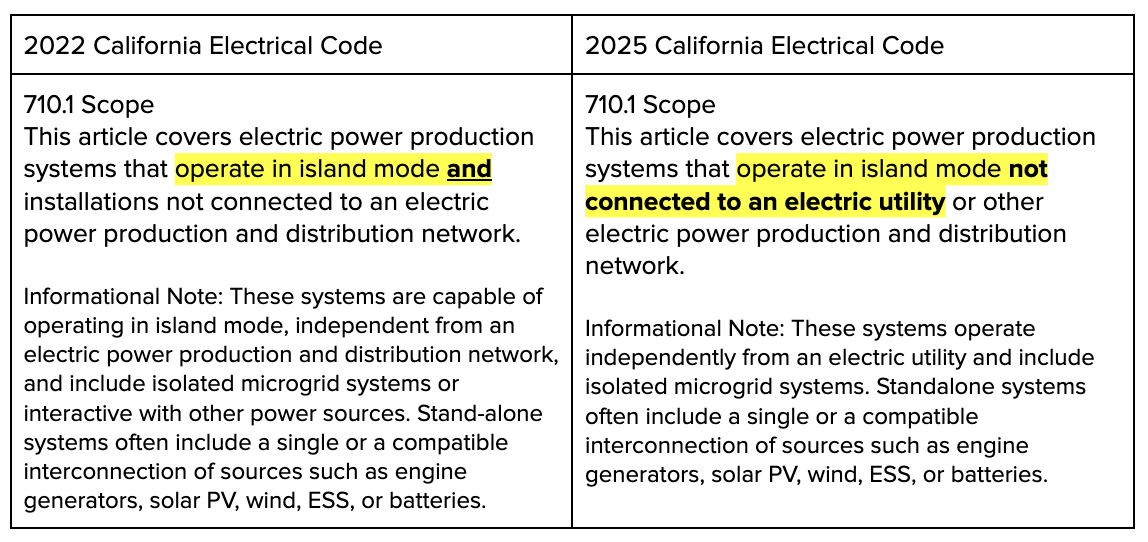
Under the 2022 CEC, Article 710.15 was the reference for sizing ESS backup load circuits for utility-interactive systems. However, the 2025 CEC removes the applicability of grid-connected systems that operate in island mode from the scope of Article 710.
While Article 706.16(F) continues to point to 710.15 for backup load sizing, it now only applies to systems not interconnected to the grid (which they call “stand-alone systems”). CALSSA anticipates that many Authorities Having Jurisdiction (AHJs) will transition to referencing Article 702.4.
AHJs may still permit sizing based on 710.15. After all, existing installations permitted before January 1, 2026, do not inherently become unsafe, since for multimode inverters the change is about performance rather than safety. Nevertheless, it is expected that the majority of jurisdictions will eventually require Article 702 for utility-interactive systems.
CALSSA also foresees potential permitting challenges due to misinterpretations of Article 702 by jurisdictions. ESS sizing under the 2022 CEC and prior codes relied on Article 710.15, focusing on the single largest load. This approach allows ESS backup to be connected to all loads of the home, without requiring ESS oversizing for simultaneous operation of multiple high-demand appliances during grid outages.
However, during the 2023 NEC code development process, the code-making panel reduced the scope of stand-alone systems, restricting Article 710 to only off-grid systems.
While there is not a direct pointer to Article 702 Optional Standby Systems, it is the most applicable section for multimode systems capable of operating both in island mode and in parallel with the grid.
Article 702.4(A) System Capacity currently provides two pathways for sizing backup load circuits:
Manual and Nonautomatic Load Connection
If the connection of load is manual or nonautomatic, an optional standby system shall have adequate capacity and rating for the supply of all equipment intended to be operated at one time. The user of the optional standby system shall be permitted to select the load connected to the system.
Informational Note: Manual and nonautomatic transfer equipment require human intervention.
2. Automatic Load Connection
If the connection of load is automatic, an optional standby system shall comply with 702.4(A)(2)(a) or (A)(2)(b) in accordance with Parts I through IV of Article 220 or by another approved method.
(a) Full Load. The standby source shall be capable of supplying the full load that is automatically connected.
(b) Energy Management System (EMS). Where a system is employed in accordance with 750.30 that will automatically manage the connected load, the standby source shall have a capacity sufficient to supply the maximum load that will be connected by the EMS.
Article 702.4 was originally written for traditional standby generators that do not provide grid support functions and only operate during an outage. Multimode optional standby systems, on the other hand, normally operate in parallel with the grid but can also provide backup during grid outages. When a grid outage occurs, it can maintain the connection as the system islands the home for backup. This is different from a traditional standby generator that is only energized and connected to the load in a grid outage. While generators can operate in a brownout condition and potentially damage loads, if an inverter-based system is temporarily overloaded, it will shut down safely.
The challenge is that multimode inverter-based systems typically have both automatic and manual/nonautomatic-like functions, and do not fit neatly into either option. This is due to the inherent user interaction with these systems. The following are possible compliance pathways under Article 702.4 for multimode ESS:
Manual and Nonautomatic Load Connection
The ESS has a manual backup connection option (i.e., in event of a grid outage, the homeowner would be required to manually enable the home backup power), or
The ESS has nonautomatic load management functions that can prompt the user to manually manage their loads (for example, notifications about reducing power consumption and/or providing load selection via a product app)
Automatic Load Connection
Install a dedicated backup panel
Increase the total power output capacity of ESS
Install/integrate load shedding (EMS or PCS), like a smart panel or other listed device
In the 2026 National Electrical Code (NEC), a third option was added to Article 702.4:
(3) Multimode Inverter-based Systems in One- and Two-Family Dwellings
For one- and two-family dwellings multimode inverter based systems listed as a PCS for overload control shall have a minimum capacity equal to the PCS control setting of the standby source in accordance with Article 130 Part II and no less than the load posed by the largest single utilization equipment connected to the system. If a shutdown occurs in response to an overloaded condition, reconnection of the supply shall only be performed nonautomatically.
Informational Note No. 1: Multimode-inverter based systems often function primarily as interactive systems and are capable of providing standby supply continuity within their capacity. Multimode inverters are listed to control the voltage and frequency within prescribed limits and ratings. Multimode inverters with PCS cease operation safely in an overload condition.
Informational Note No. 2: PCS functionality is typically used to control loads at the branch circuit, feeder distribution level, or combination of both to prevent branch circuits, feeders, standby sources, and equipment from being overloaded upon connection of the load onto the standby source.
This new option will require UL 3141 PCS certification for overload control. This aspect of the UL 3141 test is still under development. It is expected to be published and available for manufacturers to test by late Q1 of 2026. While California will not officially adopt the 2026 NEC until 2028, with an effective date of January 1, 2029, jurisdictions may be willing to pull in the new language, once certified products are available.