
Members-Only Fact Sheet
AB 2143 Compliance Fact Sheet
Updated July 28, 2026
AB 2143 (Carrillo) was signed into law on September 29, 2022. The law states that “…construction of any renewable electrical generation facility, and any associated battery storage, after December 31, 2023, that receives service pursuant to the standard contract or tariff developed pursuant to Section 2827.1, shall constitute a public works project[.]” Section 2827.1 is the net metering and net billing tariffs for investor-owned utilities only. It does not apply to non-NEM projects or NEM projects in publicly owned utility territories, among other exemptions listed below.
CALSSA’s guidance on compliance with the law is based on (1) CALSSA’s evaluation of the law, (2) testimony and legislative committee reports created during the legislative process, (3) the California Public Utilities Commission (CPUC)’s Decision voted on November 16, 2023 and (4) communications sent by the Department of Industrial Relations (DIR).
The DIR may or may not issue its own guidance. Should conditions change, CALSSA will update this memo. Nothing in this document should be taken or construed as legal advice. Companies should consult with an attorney to inform their compliance with AB 2143.
What is the trigger date for individual projects to comply?
The CPUC Decision makes a project subject to the law upon submittal of a NEM/NBT interconnection application on or after January 1, 2024. It is reasonable for companies to use this interpretation from the CPUC’s Decision until and unless additional guidance is provided by the DIR.
What does AB 2143 clearly require?
Requirements concerning the payment and documentation of prevailing wage are clearly spelled out in the law in Section 769.2 (b) of the Public Utilities Code:
(b) A contractor who enters into a contract to perform work on a renewable electrical generation facility or associated battery storage described in subdivision (a) shall do all of the following:
(1) The contractor shall pay each construction worker employed in the execution of the work, at minimum, the general prevailing rate of per diem wages, except that an apprentice registered in a program approved by the Chief of the Division of Apprenticeship Standards shall be paid, at minimum, the applicable apprentice prevailing rate.
(2) The contractor shall maintain and verify payroll records pursuant to Section 1776 of the Labor Code and make those records available for inspection and copying as provided in that section. Notwithstanding Section 1776 of the Labor Code, the contractor shall not be required to provide copies of certified payroll records to any entity other than the Department of Industrial Relations and the commission.
(3) The contractor shall biannually, on July 1 and December 31 of each year, submit to the commission digital copies of its certified payroll records for projects subject to this section. The commission shall retain these records as public records for five years.
What about other public works requirements such as apprenticeship ratios or having contractors or projects register with the DIR?
Direct communications from DIR to individual solar companies strongly imply that all public works requirements, such as apprenticeship requirements and project and contractor registrations with the DIR apply and not just prevailing wage and certified payroll submissions. CALSSA is actively working to obtain clear guidance from the DIR on how contractors and their customers would be expected to comply with these requirements given the differences in nature between true public works projects and non-public works solar and storage projects. This potential revelation raises more questions than it answers but CALSSA feels it important that the industry be made aware.
Which jobs must comply with AB 2143?
First of all, AB 2143 only applies to net metered projects, whether “NEM 1.0”, “NEM 2.0” or “NEM 3.0” (also known as Net Billing) built within an investor-owned utility territory. It does not apply to non-NEM projects, nor does it apply to projects built within a publicly owned utility such as LADWP or SMUD.
Within those parameters, AB 2143 applies to the construction of all commercial projects regardless of system size. The law provides no exception for small commercial systems but rather captures any and all solar and solar + storage systems installed under the NEM tariff (regardless of NEM 1, 2 or 3) for commercial properties.
The law also applies to all multifamily housing projects greater than two stories and larger than 15 kW.
Single-family homes, as well as modular homes, are exempt from the bill. Work that is considered “Public Works” by the state of California is also exempt from the bill.
Must projects in CCAs within IOU territories comply with AB 2143?
Yes. If the project is a NEM project and meets the specifications listed above, the fact that it is being built in an area covered by a CCA bears no relevance on the applicability of AB 2143.
Will O&M jobs need to comply with AB 2143?
While AB 2143 was not explicit that O & M jobs must pay prevailing wage, maintenance is generally covered under Public Works requirements so it likely is required.
Will increasing the system size of a project or adding storage require compliance with AB 2143?
Yes. The Decision says that submitting an interconnection application to increase the system size or pair an energy storage system would need to comply with AB 2143.
How will the Utilities know if my project must comply with AB 2143?
The utilities have created a simple checklist that applicants complete as part of the interconnection process to determine whether or not the project must comply with AB 2143. The checklist created by the utilities is as follows:
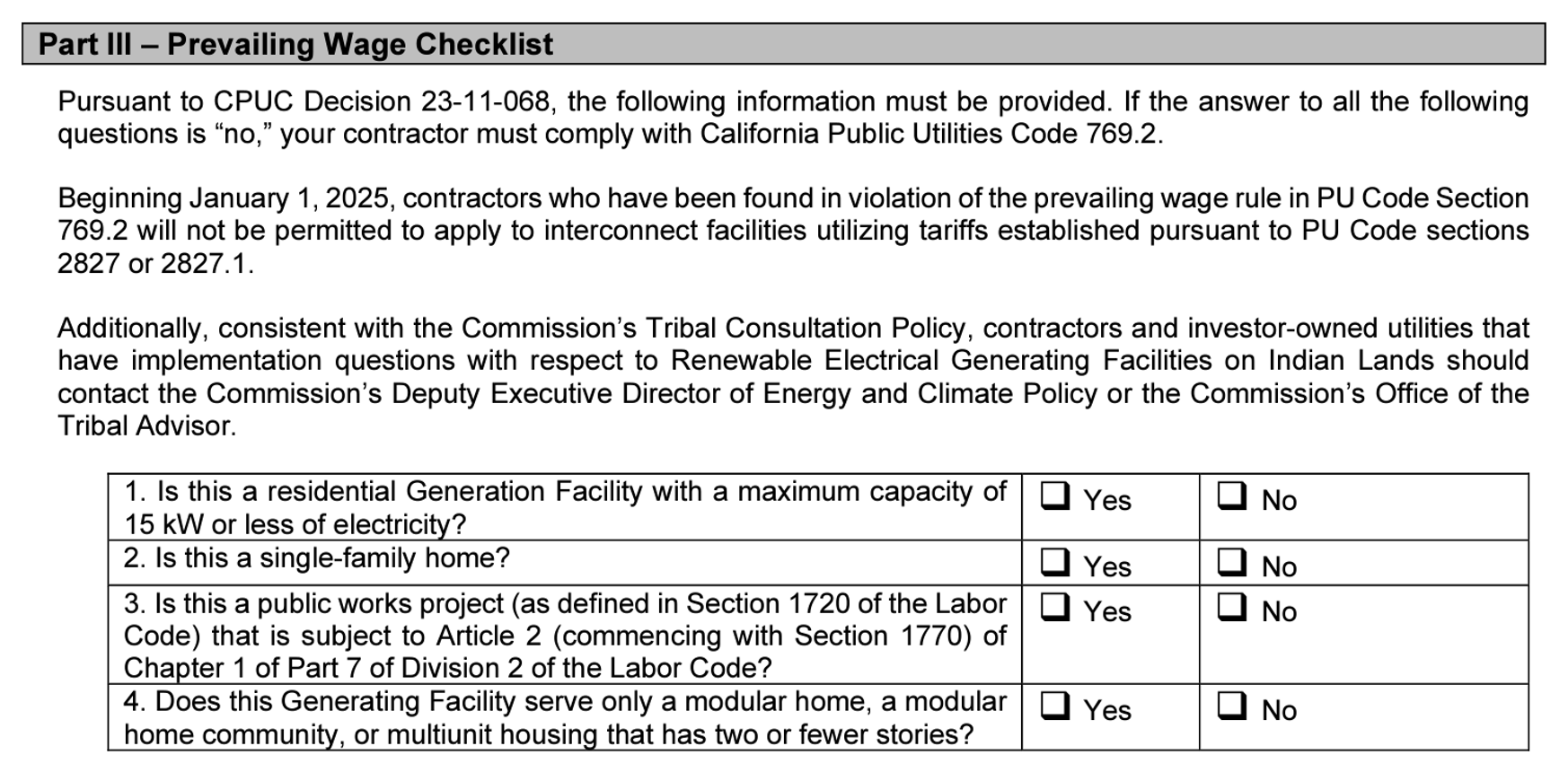
Will I need to inform my customers about AB 2143?
Yes. The Utilities created a “Disclosure” form where customers need to acknowledge receipt of the form as part of the interconnection process. Both the checklist and customer disclosure can be found here for PG&E, here for SDG&E, and here for SCE.
What is the process to submit certified payroll records?
The law requires Contractors to submit certified payroll records to the Commission biannually on July 1 and December 31. The Decision authorizes the Commission to hire a consultant to develop a system to accept the certified payroll records. To learn more on how to submit these documents, please go here.
What is the penalty for failing to submit certified payroll records?
Noncompliance with this requirement will cause the contractor to lose access to NEM and all applications will be paused until the requisite payroll records are submitted.
What if a contractor does not comply with AB 2143?
The law says:
“If a willful violation of this section has been enforced against a contractor for the construction of a renewable electrical generation facility pursuant to subdivision (c), that facility shall not be eligible to receive service pursuant to a standard contract or tariff developed pursuant to Section 2827 or 2827.1.”
This means the customer will lose access to the NEM tariff for a contractor’s failure to comply with AB 2143. The Commission goes further and says that, after January 1, 2025, a contractor found in willful violation will no longer be able to submit NEM applications.
What does a willful violation mean?
Section 1771.1 of the Labor Code says, "(e) A willful violation occurs when the contractor or subcontractor knew or reasonably should have known of his or her obligations under the public works law and deliberately fails or deliberately refuses to comply with its provisions."
The CPUC’s decision says that the DIR, not the CPUC, will make a “willful violation” determination.
What is the process by which a customer will lose access to NEM?
The decision says that after the DIR makes a determination of a “willful violation,” they will share this information with the Utilities. The Utilities will then notify the customer of the lost tariff access and at least 30 days from the notice, the customer’s tariff will be adjusted. For VNEM accounts, this will be a 60-day advance notice.
Will the customer receive any compensation for exports without NEM?
Yes. The decision requires the Utilities to treat the customer’s solar facility as a “Qualifying Facility” under the Public Utility Regulatory Policies Act of 1978 (PURPA). This means the customer will be paid, “…the avoided cost for that purchase, meaning the incremental cost to the utility of alternative electric energy.”[1] The tariff has not yet been approved.
What if we want to add standalone batteries to an existing commercial NEM system? Do we need to comply with AB 2143?
If the addition interacts with the existing NEM system, it is considered a NEM project and needs to comply. If it is operated separately as non-export, there is not clear guidance but it is CALSSA’s interpretation that it does not need to comply with the requirements.
Are non-export additions to existing NEM systems for commercial customers subject to AB 2143?
If the system is operated separately as non-export, it does not need to comply with the requirements.
Does PV on a commercial meter in a multifamily project need to comply with AB 2143?
if a multifamily property is otherwise exempt from AB 2143, a common area commercial meter qualifies for the exemption.
Does AB 2143 apply to a three-story multifamily project where the first story is a garage?
Yes. A garage level counts as a story when determining whether a multifamily property qualifies for the two-story exemption, regardless of whether the garage is aboveground or underground.
The law says that for residential projects greater than 15 kW on a multi-unit building larger than two stories, we need to comply with AB 2143. Is that AC or DC?
The 15 kW is measured in AC.
Does AB 2143 apply to ADU construction?
If the account will be on a residential rate, it will not need to comply with AB 2143.
PREVAILING WAGE
What is prevailing wage?
From DIR: All workers employed on public works projects must be paid the prevailing wage determined by the Director of the DIR according to the type of work and location of the project. The prevailing wage rates are usually, but not always, based on rates specified in collective bargaining agreements.
Prevailing wages are set according to occupation type and by county.
What is the prevailing wage rate for a solar installer?
There is no “solar installer” job classification according to the DIR. The two most commonly used classifications are “Laborer” and “Electrician-Inside Wireman” but many contractors working on true public works projects also use Structural Engineers and Steelworkers. It very much depends on the nature of the work being done.
The appropriate classification for solar work is also subject to regional decisions. For example, the DIR in February of 2010 released multiple notices regarding “…the prevailing wage rates for the installation of solar and photovoltaic systems in Los Angeles, San Diego and Imperial Counties.”[1] They determined the correct job classification was “Electrician-Inside Wireman.” For work in all other counties, the appropriate wage classification has not been settled by the DIR.
Given all these dynamics, CALSSA recommends businesses consult with their legal counsel on the most appropriate wage classification given the scope of work.
Where can I find the appropriate wages for the “Laborer” classification?
Click here for Northern California [2], click here for Southern California, and click here for San Diego. Once there, click on the corresponding dropdowns. The exact wage will be determined by the exact Laborer classification as well as the relevant county.
Where can I find the appropriate wages for Inside Wireman?
For Inside Wireman wages, you must search county by county. Click here, then choose the relevant county, then Inside Wireman. You should also click here to see if there are wage shift differentials.
For a DIR FAQ on Prevailing Wage, go here.
For a link to DIR-sponsored Prevailing Wage seminars, go here
………………………….
[1] Commission Decision, pp. 187-188.