
MEMBERS-ONLY FACT SHEET
EV Charging Mandate for Parking Canopies
Last updated November 11, 2024
Commercial customers that build new solar carports must install EV charging infrastructure. This includes a number of chargers and a number of charger-ready spaces. There is also a requirement for handicapped accessible charging spaces. These requirements apply all non-residential customers, including schools. It covers projects with building permits submitted after July 1, 2024.
These requirements are in the 2022 CALGreen July 1st Supplement. Schools that are covered are K-12 public schools and community colleges under the jurisdiction of the California Division of the State Architect (DSA). Non-residential occupancies administered under the Building Standards Commission (BSC) differ slightly from the mandates under DSA. This factsheet includes the basic requirements for both.
I.Basics
If you have a permit application that was submitted prior to July 1, 2024, these new requirements do not apply. If an AHJ disputes this you can reference CA Health and Safety Code 18938.5. (a).
Not currently required for residential parking lots, including multifamily, condos, hotels, and motels
II. EVCS in Nonresidential Occupancies (CALGreen 5.106.5.4)
EVSE mandates are required “when a new photovoltaic system is installed covering existing parking spaces” (CALGreen 5.106.5.4)
Mandates apply to the number of parking spaces altered (CALGreen 5.106.5.4.1)
If the parking lot has existing EV capable infrastructure, the existing EV infrastructure can be utilized to comply, and the total requirement is still based on the number of parking spaces altered. (CALGreen 5.106.5.4.2)
Exceptions to the EV mandate can be made by the jurisdiction on a “case-by-case basis,” when:
There is no local utility power supply, or
The utility is unable to supply adequate power, or
The additional local utility infrastructure required to comply would “adversely impact the construction cost of the project,” or
Otherwise “demonstrated as impracticable”
A. Calculating the number of EV spaces needed for Nonresidential Occupancies
An EV capable space is “A vehicle space with electrical panel space and load capacity to support a branch circuit and necessary raceways, both underground and/or surface mounted, to support EV charging.” (CALGreen Section 202: Definitions)
CALGreen Section 5.106.5.3.1 provides specific compliance requirements
An electric vehicle charging station (EVCS) has “electric vehicle supply equipment (EVSE)” installed. (CALGreen 5.106.5.3.2)
One EV charger with multiple connection ports is permitted as long as it is capable of charging multiple EVs simultaneously. Meaning, one charger that can serve two EVs at the same time will count towards two parking spaces.
B. There are two methods for calculating the number of EV spaces needed:
i. Number of Spaces Method
Table 5.106.5.3.1 shows the number of chargers and charging capable spaces required.
When EVSE is required, at least one EVSE must be a Level 2 charger (CalGreen 5.106.5.3.2)
The number of EVCS counts toward the total number of EV capable spaces required (Footnote #2 in Table 5.106.5.3.1)
Read the table as: Of the number of EV capable spaces required in column (2), that number in column (2) needs to be equipped with EVSE as dictated in column (3). For example, if your solar carport covers 60 parking spaces, the table says 13 EV capable spaces and 3 EVCS are required. You can install 3 EVCS and 10 EV capable spaces.
Each DC Fast Charger (DCFC) counts as 5 EV capable spaces or 5 EVCS (CALGreen 5.106.5.3.2.1)
For example, if your solar carport covers 60 parking spaces, the table says 13 EV capable spaces and 3 EVCS are required. If you install 2 DCFC, those count for 10 EV capable spaces and you do not need any additional EV capable spaces. Those 2 DCFC also count as 10 EVSE and comply with the 3 EVSE requirement. However, since footnote #3 says at least 1 Level 2 charger is required, an additional 1 Level 2 EVSE must be installed with the 2 DCFC.
Two “low power Level 2 EV chargers” count towards one EV capable space. (CALGreen 5.106.5.3.2.2)
We understand Low Power Level 2 EV Charger to mean a 208/240-volt 20-ampere minimum electric vehicle charger. Whereas a Level 2 EV Charger is defined as “A 208/240-volt 30-ampere minimum electric vehicle charger connected to the premises electrical system capable of charging electric vehicles.” (CALGreen Section 202: Definitions).
For example, if your solar carport covers 25 parking spaces, Table 5.106.5.3.1 says 4 EV capable spaces are required and no EVCS is required. However, you may choose instead to install 8 low power Level 2 chargers instead of 4 EV capable spaces.
ii. Power Allocation Method
Table 5.106.5.3.6 using the power allocation method is intended to be equal to using Table 5.106.5.3.1. Using either method should achieve the same power allotment.
Use any kVA combination of EV capable spaces, low power Level 2, Level 2 or DCFC EVSE. However, the maximum allowed kVA to be used for EV capable spaces is 75%.
At least 1 Level 2 EVSE is required.
To determine the kW needed for the chargers, use the formula for Kilovolt-amps (kVA) to Kilowatts (kW)
Apparent power (kVA) x power factor (pf) = actual power (kW)
C. Accessible EVCS required per charging level & type (CalGreen 5.106.5.4)
When EVSE is installed, accessible EVCS shall be provided in accordance with the California Building Code (CBC), Chapter 11B, Section 11B-228.3
For the number and types of ADA spaces, use Table 11B-228.3.2.1
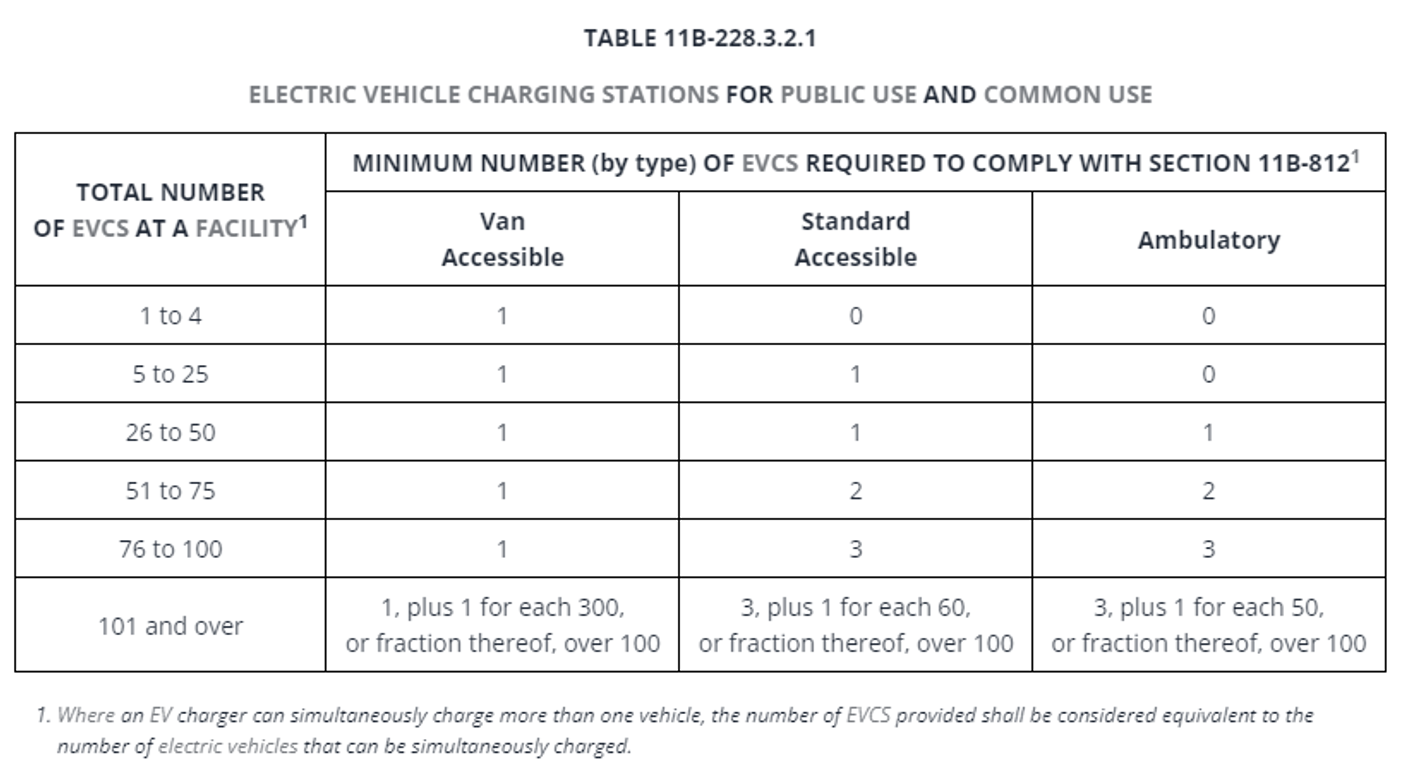
Example 1: If there are 4 Level 2 chargers, then 1 of 4 needs to be Van Accessible.
Example 2: If there are 2 Level 2 chargers, and 2 DC Fast Chargers, then 1 of 2 Level 2 charger and 1 of 2 DC Fast Chargers need to be Van Accessible.
One EV charger with multiple connection ports is permitted as long as it is capable of charging multiple EVs simultaneously.
Accessible EVCS shall also follow the requirements in CBC Section 11B-812
EV chargers shall also comply with:
CBC Section 11B-309.4 for operable parts
CBC Section 11B-302 for floors and ground surfaces
CBC Section 11B-206.4 for accessible route to the building or facility
CBC Section 11B-402 for accessible route to the EV charger
III. EVCS in Schools and Community Colleges (2022 CALGreen 5.106.5.6.4.2)
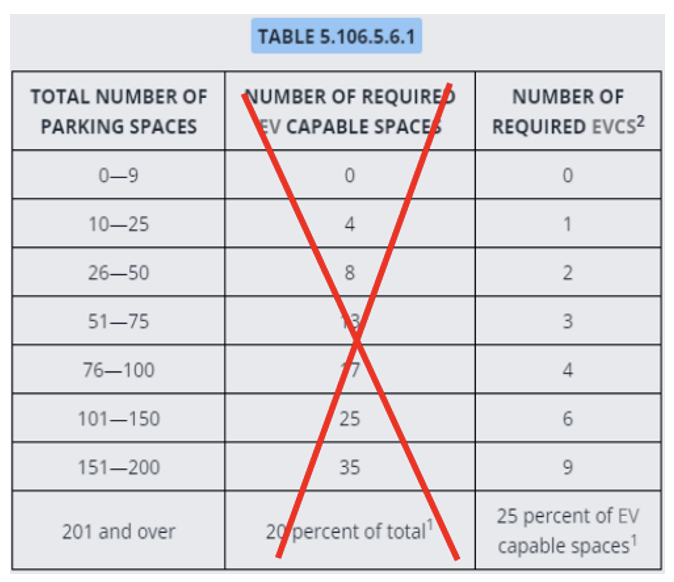
EV mandates for public schools (K-12) and community colleges are very similar to the nonresidential requirements, with some differences:
The number of EVCS required is based on the total number of parking spaces, not only the ones being altered. However, EV capable spaces are not required. (CALGreen 5.106.5.6.4)
Each DC Fast Charger (DCFC) still counts as 5 EVCS. However, there are no reductions for low power Level 2 EV chargers, which would be moot regardless since EV capable spaces are not required for this situation.
If the project is required to be submitted for approval through the Division of the State Architect per California Administrative Code Section 4-309 for projects over $100,000 in cost, and if the public school or community college has existing EV capable spaces, then Level 2 EVSE is required to be installed on all existing EV capable spaces. Summary: DSA + existing EV capable spaces = Install Level 2 EVSE (CalGreen 5.106.5.6.5)
Accessible EVCS shall be provided in accordance with CBC Chapter 11B, which includes all the same accessibility requirements as nonresidential