
MEMBERS-ONLY FACT SHEET
NEM2 Three Year Build Deadline
Last Updated December 5, 2025
The deadline to submit NEM2 applications was April 14, 2023. Similarly, the deadline to submit NEM2A and NEM2V applications was February 14, 2024. Applications submitted before these dates are only allowed to maintain their NEM2 status if the correct final documents are submitted before the correct deadlines.
Originally, the Commission ruled that these final documents must be submitted by three years from application submittal. However, after collaborative discussion between stakeholders, the IOUs published tariffs that established a more reasonable deadline. Additionally, the language allows utilities to grant extensions to the deadline in the case of utility-caused delays. This fact sheet outlines the right deadline for your project, what specific final documents must be submitted before the deadline, how extensions work, and the consequences for applications that miss the deadline.
When is the deadline?
Table 1 outlines the deadline for each project type. The deadlines are the same across the utilities.

* On June 9, 2025, PG&E submitted an advice letter attempting to shorten the NEM2A build deadline to April 14, 2026, specifically for NEM2A applications that were submitted on or before April 14, 2023. However, CALSSA defeated PG&E’s attempt - the CPUC sided with CALSSA. The deadline remains at February 14, 2027 for all NEM2A and NEM2V projects.
** On May 8, 2025, SCE submitted an advice letter attempting to shorten the deadline for NEM2A and NEM2V applications submitted on or before April 14, 2023, to April 14, 2026. However, CALSSA defeated SCE’s attempt - the CPUC sided with CALSSA. The deadline remains at February 14, 2027 for all NEM2A and NEM2V projects.
2. What must be submitted by the deadline?
To satisfy the requirements of the deadline, the tariffs state that customers “shall submit final building permit sign off and electrical clearing by the authority having jurisdiction.”[1] More specifically, the IOUs have clarified in writing that it is sufficient for customers to submit AHJ electrical final sign-off, including the generating facility, if the solar installation is part of a larger project. For example, some customers have jobs that include constructing new buildings, planting trees, etc., especially for new construction sites. The building components unrelated to solar are not required.
3. How can you request an extension to the deadline?
The tariffs state that when a project experiences utility-caused delays, the utility has discretion to grant extensions to the three-year build deadline. For example, PG&E’s NEM2 tariff states:
PG&E is granted the discretion to give NEM2 tariff eligibility to a customer if a delay in meeting the NEM2 Sunset Date (April 14, 2023) or NEM2A Sunset date (February 14, 2024) is caused by the utility. Similarly, PG&E has the discretion to apply NEM2/NEM2A eligibility to customers who fail to submit the final building permit sign off and other necessary documentation within three years from the NEM2 sunset date (before April 15, 2026), or for Load Aggregation Customers three years from NEM2A Sunset date (before February 15, 2027) if such failure is due to utility-caused delays.[2]
This provision is the same across the utilities for all NEM2 projects. At the Interconnection Discussion Forum, all three IOUs clarified that they would consider extension requests on a case-by-case basis. However, PG&E and SCE have been very difficult to work with on this issue so far. They refuse to give concrete guidance and continually delay granting extensions until the deadline is “closer.” CALSSA does not expect PG&E and SCE to be helpful with extensions.
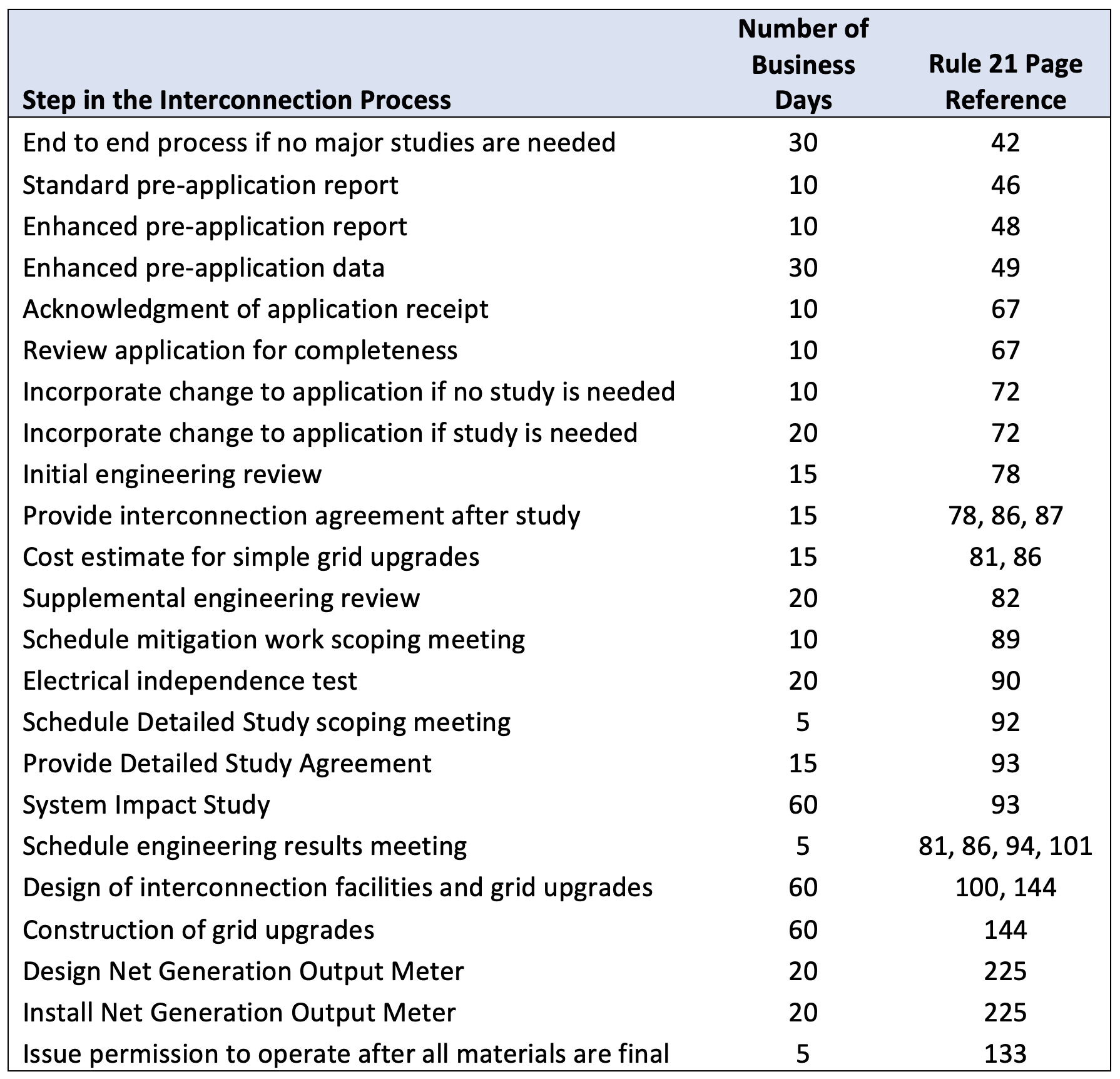
The utilities have informally said that extensions will be granted following a “day-for-day” policy, where for each day of utility-caused delay, the customer would be granted an additional day on top of the original deadline. It will be easiest to request extensions based on delays in stages that have established Rule 21 timelines. When a step in the process has a Rule 21 stages have timelines that the utilities are expected to follow, making it straightforward to state that a utility has gone over the mandated time limit. These stages and the associated timelines are summarized here for easy viewing.
CALSSA encourages contractors to also request extensions for delays in non-Rule 21 stages. It may be more ambiguous and difficult to get the utilities’ agreement on what constitutes a delay, but the tariff provision is for any utility-caused delay, not just those that have timelines in Rule 21.
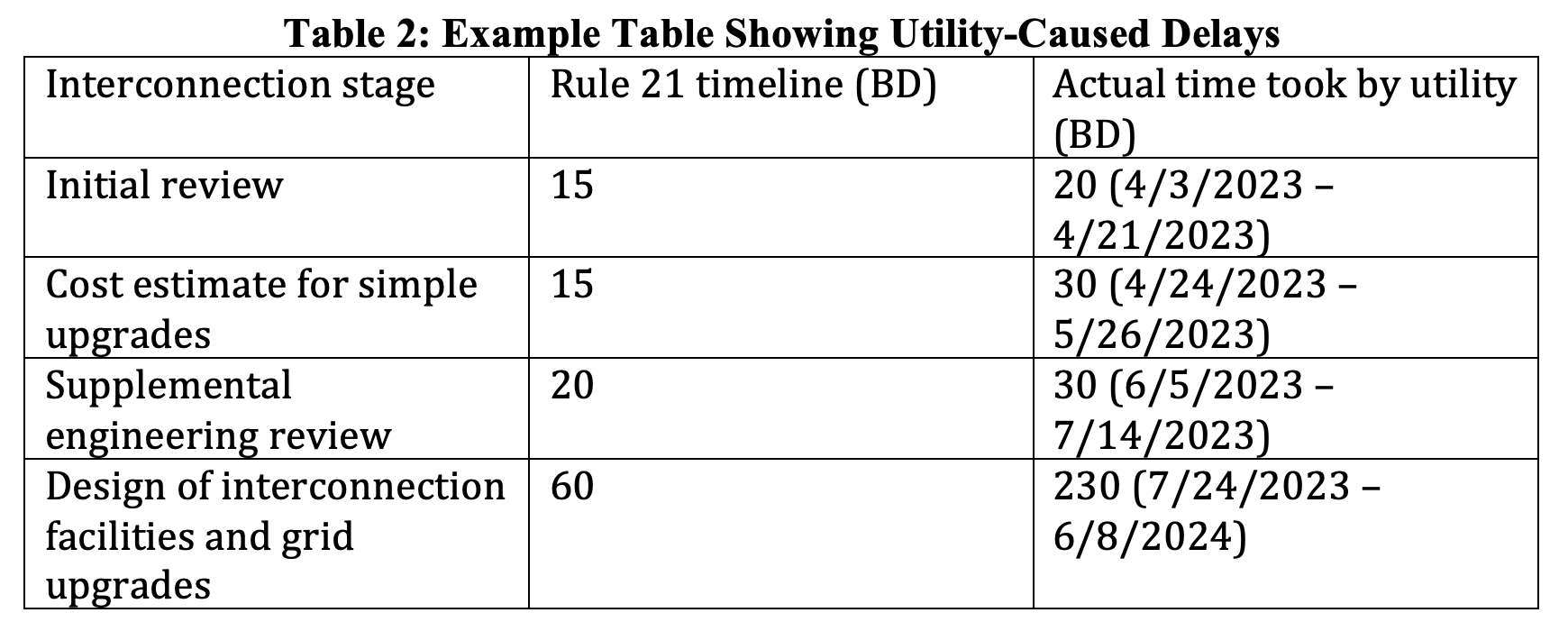
The customer’s extension request must include a timeline summarizing when each utility delay occurred and how long it persisted for. This timeline should be detailed and be broken down by interconnection stage. An example is Table 2.
For PG&E, customers/contractors should first send their extension request to the project’s assigned IM. If the IM does not respond substantively within two weeks, please notify CALSSA at interconnection@calssa.org. SCE has stated they would provide the contact information of the right point-of-contact but is still in the process of identifying this person. For SDG&E, contact Tracy Alexander at talexander2@sdge.com.
4. What happens to applications that miss the deadline?
The treatment differs across the utilities. PG&E will not automatically cancel existing NEM2 applications and require resubmittal. However, PG&E may require new agreements to be signed and uploaded to the portal. SCE will not require resubmittal for projects with an assigned advisor in Grid Contracts. However, SCE will require resubmittal for all other projects. SDG&E will require resubmittal for all projects.
There are concerns over the logistics of submitting new applications. Customers want to keep their progress through engineering studies and review. With PG&E, this is a non-issue since a new application does not need to be submitted. With SCE, include the original NEM 2.0 project number in the “Applicant Comments” field of the new application. SCE will attempt to use this manual method to keep applicant progress.
Projects that were previously exempt from prevailing wage will keep their exemption, even if they have to submit a new application. Reach out to Josh, at josh@calssa.org, for more questions on this.
5. What are the Rule 21 timelines?
The following tables list the steps in the process that have specified timelines in Rule 21. The page references may be approximate due to differences between the IOUs and changes to Rule 21.
………………………..
[1] PG&E NEM2 tariff, Special Condition 3(ii).
[2] PG&E NEM2 tariff, Sheet 18