
MEMBERS-ONLY FACT SHEET
Non-Export Systems
Last Updated April 18, 2026
There are several reasons to configure solar and storage systems as non-export.
NEM add-ons: You can add a non-export system behind the same meter as a NEM-1 or NEM-2 system without losing the NEM status of the original system. Commonly referred to as non-export add-ons or non-export expansions.
Public works law: AB 2143 requires prevailing wage and apprenticeships for all non-residential solar systems and for high-rise multifamily larger than 15 kW. However, this law does not apply to systems that do not use NEM/NBT. Systems installed under the Rule 21 non-export rules are not NBT.
Interconnection: You can install a non-export system in a location where grid capacity is insufficient for an exporting system.
The most common non-export approach is to use a certified power control system (PCS). A PCS can reduce the output of solar and storage in response to a power flow measurement. It can be contained within an inverter, battery controller, or hub. The PCS setting is established at installation.
In the basic PCS configuration with a single solar and storage system behind one meter, the measurement is at the service point. If a CT measures power flowing in the direction from the customer site to the grid, the PCS will shut down system production within two seconds. When power flows from the grid to the site, the system can produce power for onsite loads.
Until recently, the PCS standard was an optional component of UL 1741 known as a certification requirements decision (CRD). This has been converted to standalone PCS standard, UL 3141, which is being phased in to replace the UL 1741 CRD. The utilities will continue to accept UL 1741 CRD for most cases - however, for NEM add-ons Configuration #1 specifically (described later in this fact sheet) , the utilities are requiring UL 3141.
To find equipment with certified PCS:
Go to the CEC Approved Equipment List at https://www.energy.ca.gov/programs-and-topics/programs/solar-equipment-lists.
Under Power Control Systems, you should see two different lists - a new PCS list for UL 3141 and a legacy PCS list for UL 1741 CRD. Your equipment might be on either of these two lists, depending on when the manufacturer submitted their listing request to the CEC.
Click on Download Excel file on the right side.
Check that specific columns have the correct values. What you need to look for depends on your desired configuration, i.e whether you are doing standalone non-export or NEM add-ons. This is explained below.
Standalone Non-Export
The equipment must be listed on the CEC PCS list as follows:
The Import Only Mode column must be marked “Y”.
The Max Open Loop Response Time for Import Only Mode must be 2 seconds or less.
Note: It is also required that the time to steady state be 10 seconds or less. This attribute is not listed on the CEC PCS list as of April 18, 2026, but should be on the NRTL report. SCE may be the only utility enforcing this.
Follow manufacturer instructions to set the PCS to Import Only Mode when you install it.
The reference point of the PCS must be the entire system rather than only the battery.[1]
Systems will require a CT or other measuring device at the service point. Follow manufacturers instructions.
The non-export options are contained in Screen I in Section G of Rule 21. Certified PCS is Option 8 in Screen I. It is also possible to use a non-export relay (Option 1). This can cost around $50,000 and is challenging to program correctly. Another option is to size the system no more than 25% of the site’s original service rating and 50% of the service transformer rating (Option 3) or no more than 50% of the customer’s minimum load over the past twelve months (Option 4). The other Screen I options are for inadvertent export or limited export. Those are not non-export.
Non-export applications have a higher interconnection application fee: $800 instead of the $90-$145 charged for NBT applications. Also, NEM/NBT contains exemptions from standby charges and departing load charges.
Customers with solar smaller than 1 MW are exempt from standby charges even if they do not participate in NEM/NBT. Non-NEM/NBT systems larger than 1 MW are subject to standby charges that can be large. See PG&E Schedule SB, SCE Schedule S and Schedule TOU-8-S, and SDG&E Schedule S.
Departing load charges are non-bypassable charges assessed on the amount of load that is served by self-generation. Solar customers not using NEM/NBT pay these charges. See PG&E Schedule DCG, SCE Schedule CGDL-CRS, and SDG&E Schedule CGDL-CRS.
NEM Add-Ons
NEM-1 and NEM-2 customers can add capacity without losing NEM status if the new capacity is managed separately as non-export. This involves different configurations from single-system installations.
In all of these configurations, the combined system must still be sized to onsite load, so the customer cannot have the old system effectively operating as a wholesale generator while the new system is taking care of all onsite consumption.
PG&E is currently charging $145 for the application fee, the same fee that NEM/NBT applications pay. However, SCE and SDG&E are both charging $800, which is higher than the NEM/NBT application fee.
The utilities are accepting two system configurations for NEM add-ons.
Configuration 1. Dynamic PCS
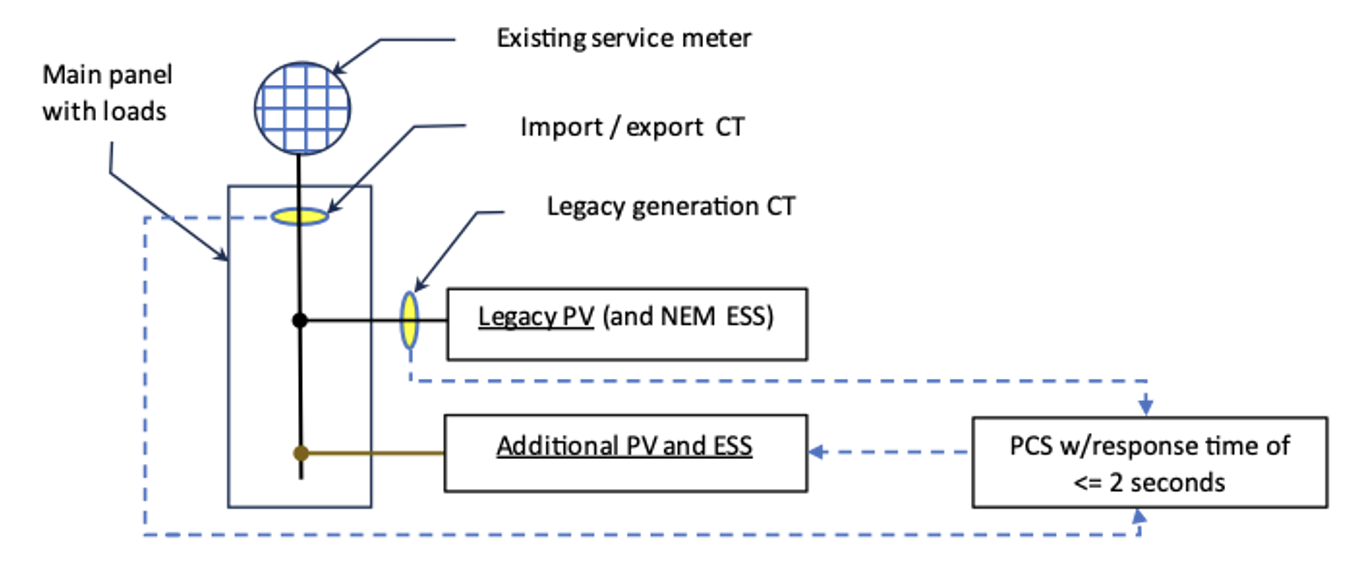
A power control system can be installed to ensure that the amount of energy exported from the site to the grid at any time is no more than what the legacy capacity is producing at that time. The PCS operating mode is certified to perform this way and the customer cannot switch to another operating mode, so verification is at commissioning without ongoing metering.
This function is slightly more advanced than the first version of PCS. With single systems, the power controls act in response to a single measurement at the meter. If power is flowing from the customer to the grid, the non-exporting devices must not be producing power. For hybrid systems, the legacy capacity can be exporting as long as the new capacity is not. Power controls on the new capacity act in response to measurements at both the meter and the output of the legacy system. If more power is flowing to the grid than is being produced by the legacy system, the new capacity must ramp down within two seconds.
The configuration cannot be used if the legacy system has storage set to Import Only/No Grid Exports.
The UL 1741 CRD does not test for this capability, but the capability has been incorporated into UL 3141 as the “NEM Integrity” capability. PG&E has sometimes been willing to approve equipment with this capability without certification. SCE and SDG&E have been requiring the UL 3141 NEM Integrity certification.
Once the new CEC UL 3141 PCS list is available online (as of April 18, 2026, it’s still unavailable), you can verify if your equipment has the UL 3141 NEM Integrity certification by looking for the “NEM Integrity” column there. It is possible that your manufacturer has the NRTL report verifying this capability, but they have not yet been listed on the CEC list - if that is the case, verify with your manufacturer and check if they have discussed this with the utility.
This is likely the lowest cost configuration, but it may not be available with equipment you want to use until that equipment is listed or separately approved by the utilities.
SCE has released a guide on how to fill out an application using this configuration.
Configuration 2. New Meter [Discontinued, No Longer Available]
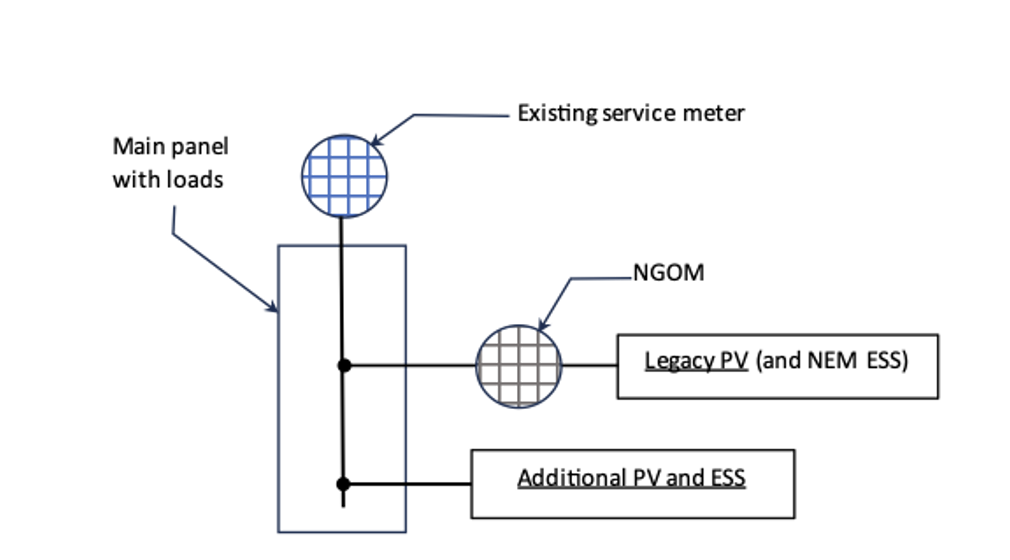
The utilities initially agreed to a configuration with a net generation output meter (NGOM) installed on the legacy capacity to verify that exports do not exceed production from the legacy system in real time. If the site is exporting more than the old system is producing, it must be coming from the new capacity, which is not allowed. Since this process has been rolled out, some customers have proposed systems with new capacity that freely exports, counting on the NGOM to clip export credits based on the production of the legacy system. Although the utilities initially agreed to this, they later realized that this approach violates the tariff, which states the new capacity must be designed as non-export. Since then, the utilities have withdrawn their initial approval of this approach.
The reversal in utility policy stranded customers who had already installed Configuration #2. CALSSA is still working on obtaining financial compensation or a tariff deviation for these stranded customers. No new applications, after the utilities changed their stance, are being accepted.
Configuration 3. New Subpanel
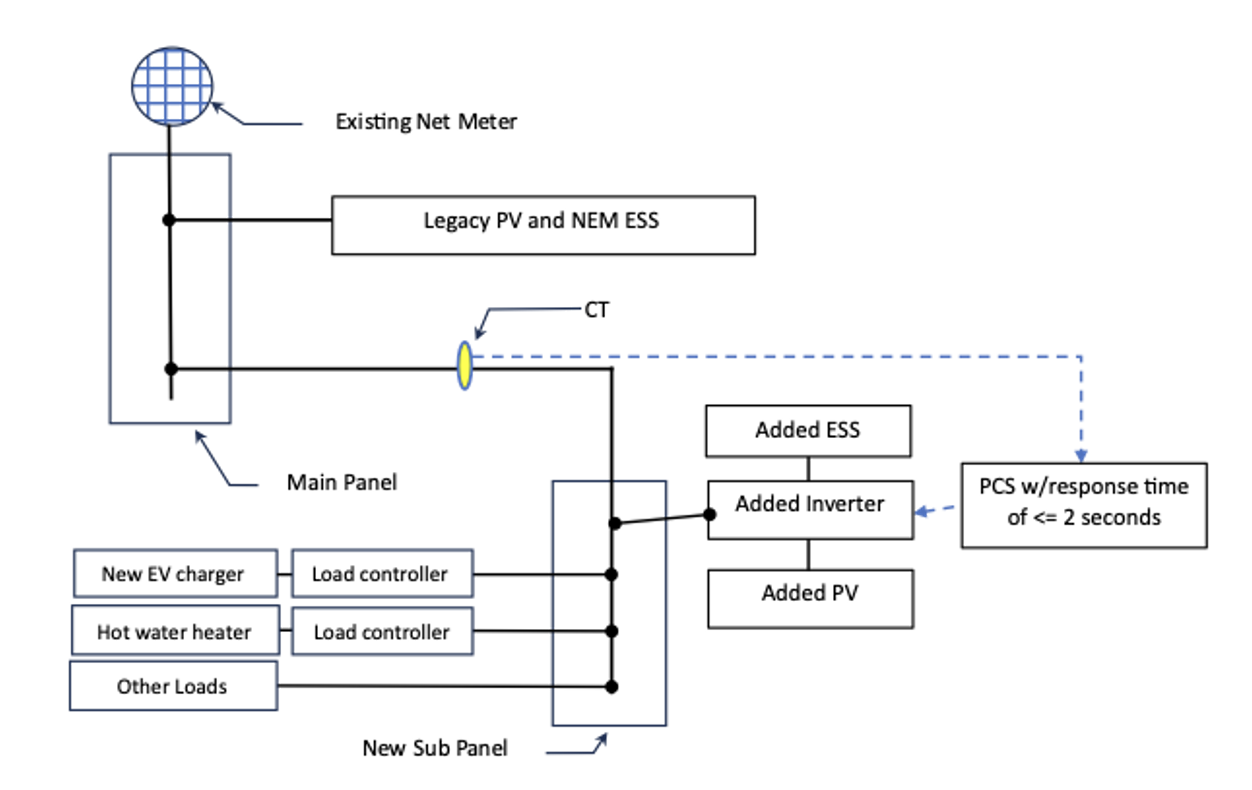
A new subpanel can be installed with new loads and/or moving old loads. The new solar and storage is installed on the new subpanel, and includes a PCS to ensure power is never flowing from the subpanel to the main service panel for more than two seconds. The new capacity feeds only the loads on the new subpanel. Power can flow from the grid to charge the new battery or feed the loads on the subpanel, but power cannot flow in the opposite direction. The new circuit is effectively load only from the utility perspective, although they are still requiring customers to submit interconnection applications.
This configuration requires the work and expense of installing a new subpanel, but it does not require UL 3141 certification. It would only require UL 1741 PCS CRD for Rule 21 Option 8 - in other words, on the CEC PCS list, the equipment must have:
The Import Only Mode column must be marked “Y”.
The Max Open Loop Response Time for Import Only Mode must be 2 seconds or less.
Note: It is also required that the time to steady state be 10 seconds or less. This attribute is not listed on the CEC PCS list as of April 18, 2026, but should be on the NRTL report. SCE may be the only utility enforcing this.
[1] In a separate use case for installing solar plus storage that exports under NEM/NBT, a PCS can be installed on the battery only, with an open loop response time of 10 seconds. See CALSSA fact sheet on NEM/NBT Paired Storage.