
MEMBERS-ONLY FACT SHEET
SGIP Requirement for Demand Response Program Participation
Last Updated December 9, 2024
All new SGIP energy storage participants must enroll in an SGIP-approved qualified Demand Response (DR) program, according to California Public Utilities Commission (CPUC) Decision 24-03-071, issued March 22, 2024.
Customers must participate in a qualified DR program for 10 years, although customers can change from the DR program in which they are enrolled to another qualified DR program.
Currently Authorized “Qualified Demand Response Programs” for SGIP
Most participants must be enrolled in one of the DR programs listed in the table below to be able to receive SGIP incentives. All of these programs are of two basic types: capacity bidding programs (CBP) and critical peak pricing (CPP). Capacity bidding programs are run by an investor-owned utility (IOU) and operated through third-party aggregators that create fleets of customer technologies that can reduce demand. Critical peak pricing plans are utility rate options that have higher charges for electricity use during times of peak demand, to encourage customers to shift energy use to other times.
Here are some top-level takeaways based on our current understanding of available DR programs:
Residential customers are eligible for the capacity bidding program, but CALSSA is not aware of any aggregators that facilitate this participation for residential customers. Therefore, residential customers are only able to use critical peak pricing plans for SGIP eligibility.
Non-residential customers can participate in CBP, but the net billing tariff already pushes batteries to discharge to offset load on most days, reducing the effectiveness and potential revenue from CBP. We therefore expect that CPP will be the main option for non-residential customers.
PG&E's residential critical peak pricing plan, SmartRate, became available for NBT customers beginning December 6, 2024.
As explained below, CCAs do not have critical peak pricing plans. Because there are no CBP providers for residential customers, this means residential CCA customers must switch away from the CCA back to full IOU service in order to receive an SGIP incentive. Some CCAs are planning to get their own DR programs approved for SGIP participation, but that has not yet happened.
SGIP PAs may propose adding new programs to the list of qualified DR programs, or the CPUC may update the list in the future. Any SGIP-approved qualified DR program must provide verifiable load drop using the storage device supported by SGIP.
Investor-Owned Utility Customers
The CPUC decision from March 2024 included an appendix listing the currently approved DR programs for the IOU territories.
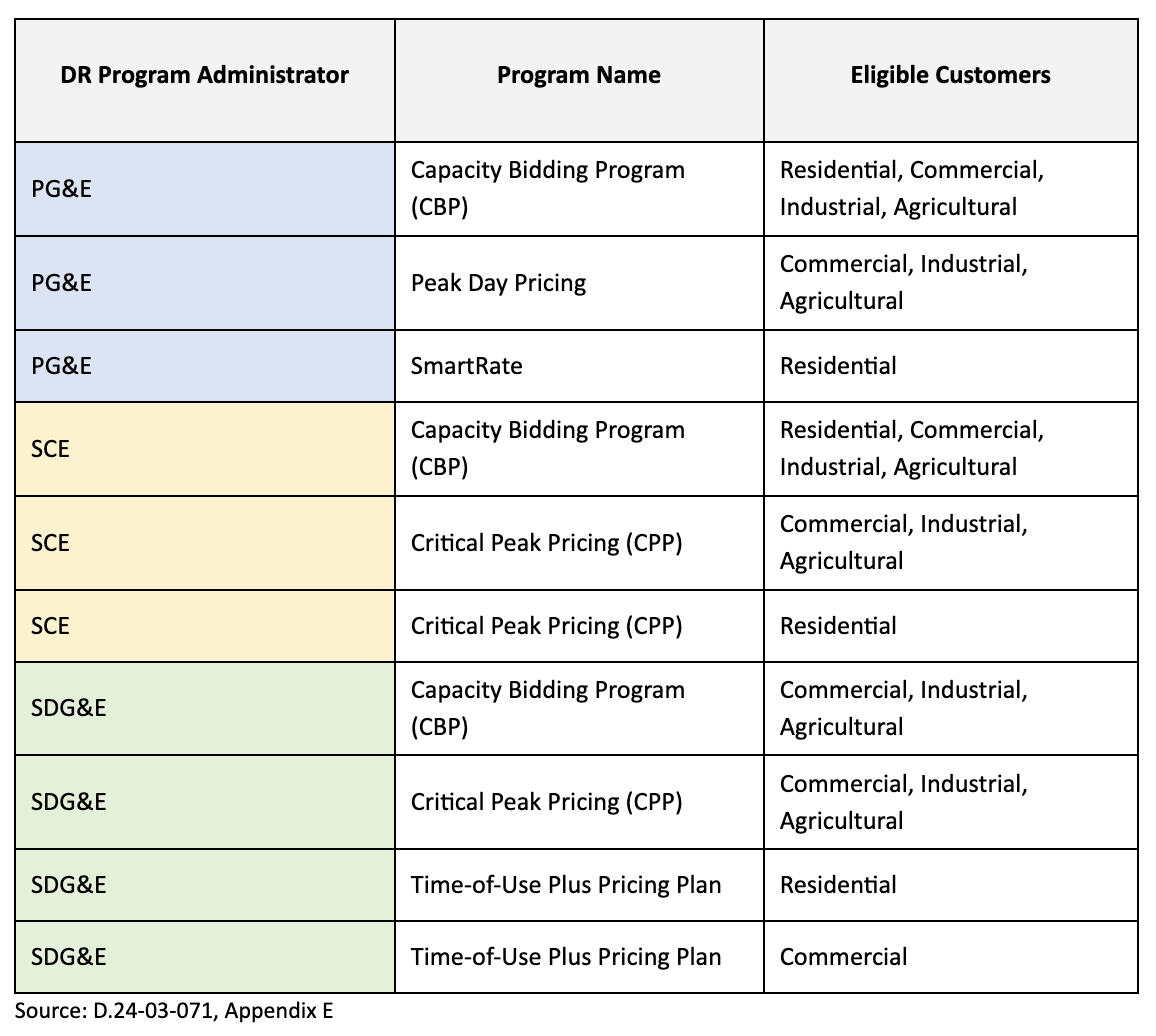
Note: Although the appendix to the CPUC decision lists SDG&E’s Capacity Bidding Program as available for residential customers, the Center for Sustainable Energy (CSE) has said that SDG&E residential customers are not eligible for CBP (even if there were available CBP providers for residential customers). CSE submitted an Advice Letter to have the list updated to reflect that fact, but it has not been addressed yet by the Commission. The table above reflects our understanding of CSE’s advice.
Community Choice Aggregator Customers
CCA customers cannot participate in the IOU critical peak pricing rates, and the CCAs do not have their own CPP rates. Thus, to be eligible for SGIP incentives, CCA customers that want to stick with the CCA would need to participate in a capacity bidding program, although CALSSA is not aware of any CBP aggregators that enroll residential customers. CCA customers could select an IOU CPP option in the SGIP application, and would need to discontinue being a CCA customer and be switched back to full IOU service before receiving the SGIP incentive.
Publicly Owned Utility Customers
We are not aware of any POU DR programs that have been approved as an SGIP-qualified DR program to date. The CPUC decision includes an exemption that the customer does not need to be in a DR program if they are a non-IOU customer and their utility does not offer a qualified DR option. In practical terms, this means all POU customers are eligible for SGIP rebates without the DR requirement.
It is CALSSA’s understanding that the SGIP PAs do not consider CCA customers to be non-IOU customers, since they still get their T&D from the IOU. CCA customers therefore are not being treated as eligible for the POU exemption.
Information on Critical Peak Pricing
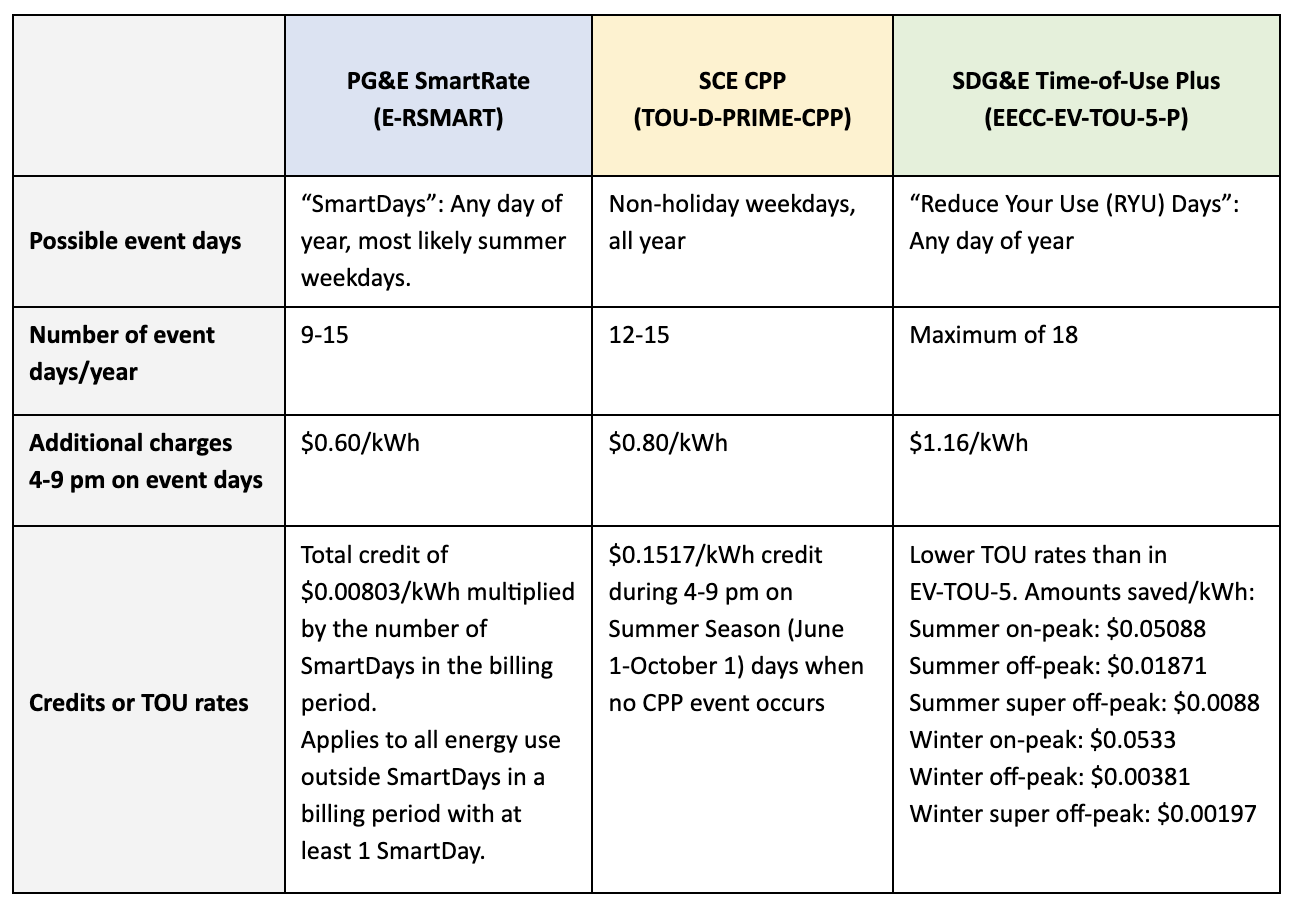
The CPUC authorized a limited number of rate-based programs as qualified DR programs. These include PG&E’s Peak Day Pricing and SmartRate, SCE’s Critical Peak Pricing, and SDG&E’s Critical Peak Pricing and Time-of-Use Plus plans. These tariffs offer a discount on electricity rates most summer days, in exchange for higher rates during a small number of called events. The events are meant to address times when the grid is stressed.
Most CPP plans are a layer on top of other standard rate plans. SDG&E’s “time-of-use plus” rates are distinct rate plans rather than a layer on standard rates.
Under the CPP-type rates, events are called at utility discretion based on conditions that vary in details across the different tariffs, but generally are conditions such as CAISO emergency alerts, utility system emergencies, extreme temperature conditions, or high forecasted wholesale energy market prices.
Event notifications happen the day before, by email or text.
CPP rates are available only to IOU bundled customers, not to CCA or direct access customers.
The table below shows some information for the CPP rates that residential IOU customers are eligible for.
PG&E's SmartRate program became available for net billing tariff customers on December 6, 2024.
For non-residential customers, most C&I rate schedules include an option for CPP rates. In some cases, the CPP rates are the default rates for C&I customers.
Some information on non-residential CPP rates is available at the IOUs’ websites:
PG&E Peak Day Pricing
SDG&E Critical Peak Pricing
SDG&E Time-of-Use Plus for Business
Consult the applicable tariffs for more information.
Information on Capacity Bidding Program
The Capacity Bidding Program (CBP) was established by the CPUC, but each IOU has a different CBP program with its own rules.
Customers participate primarily through CBP aggregators*. Not all aggregators accept all types of customers. According to information in the CPUC’s SGIP decision, residential and non-residential customers are eligible for PG&E’s and SCE’s CBP programs, and only non-residential customers are eligible for SDG&E’s CBP program. However, to our understanding, there are no aggregators currently accepting residential customers for the CBP programs run by PG&E and SCE. This means that CBP is currently not a realistic option for residential customers to be eligible for SGIP incentives.
Here is some information about how performance is measured and compensated in CBP:
Aggregators nominate amounts of demand reduction to be supplied during CBP events. Capacity payments are based on the nomination, with adjustments for actual performance, and there can be penalty payments owed by the aggregator when performance is below 60% of the nominated capacity.
Demand reduction is limited to onsite load, with no compensation for exported energy. Compensation is based on incremental demand reduction compared to other days using a baseline methodology. This means that batteries that regularly discharge to offset all or most of onsite load most days (e.g., for NBT or TOU bill savings) will have little additional capacity to offer for CBP events. For solar customers, this means that the baseline will also include solar that serves onsite load. This sometimes may leave customers with no load and no possible way to reduce load further on event days compared with other days.
The IOUs bid CBP resources into the CAISO wholesale energy market for some additional compensation, but the majority of value is from capacity payments.
Aggregators have various customer compensation models. Customers earn capacity incentive payments. Some customers also receive energy payments. The rules for receiving energy payments typically mean that CCA customers do not receive them, and there are other intricacies. Aggregators should be able to clarify the compensation structures that apply for their participants.
The IOUs’ capacity bidding program rules are subject to change. Up-to-date information can be obtained from the tariffs and at the program webpages.
PG&E: Tariff Schedule E-CBP; Capacity Bidding Program section of Demand Response programs for businesses website
SCE: Tariff Schedule CBP; Capacity Bidding Program and CBP Aggregators website. Note: SCE will close its Schedule CBP on December 31, 2024, and will replace it with a new Schedule CBP-E. The new schedule has not yet been approved by the CPUC as of December 3, 2024.
SDG&E: Tariff Schedule CBP; Capacity Bidding Program website
The following information is current as of the date of this fact sheet.
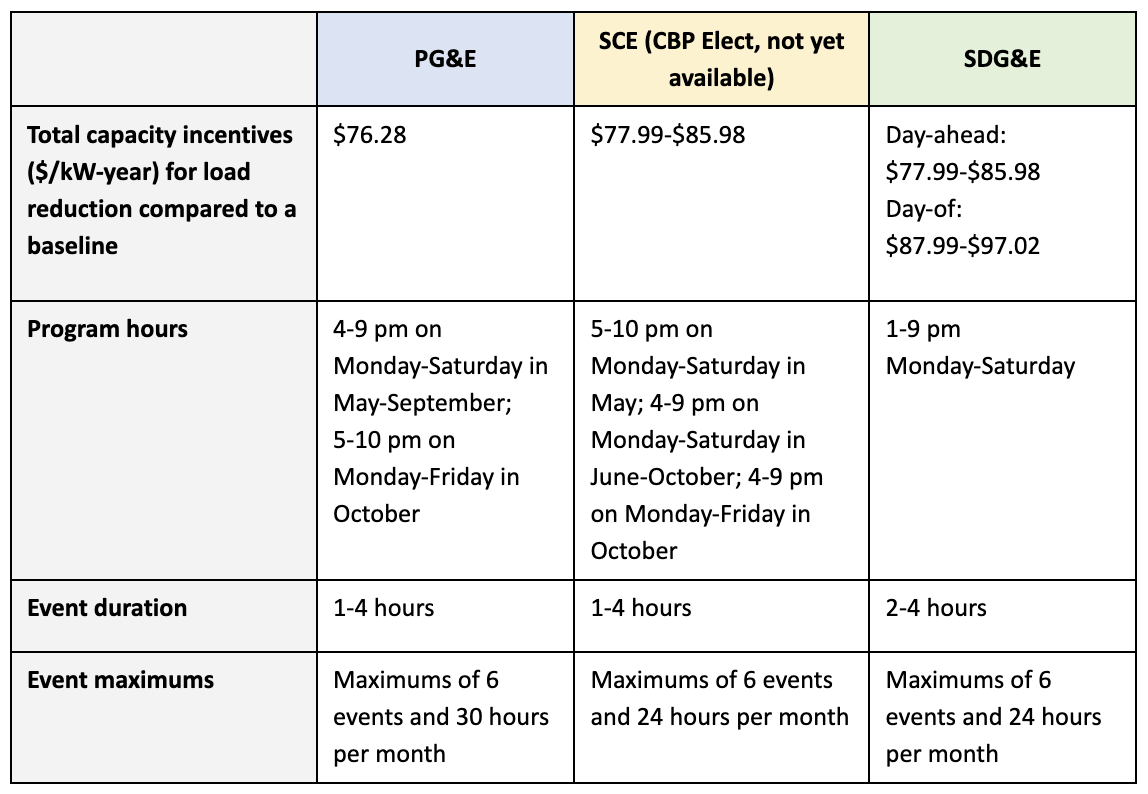
All IOUs have a day-ahead CBP option; SDG&E also has a day-of option.
CBP events vary among the IOU programs, but generally are based on high wholesale energy market prices, heat events, and grid emergencies.
CBP programs also have separate emergency events triggered by CAISO alerts and other emergency notices. Participation in this component is voluntary, and participants receive energy payments.
The table below has selected program requirements, illustrating the differences among the IOUs’ CBP programs.
* Some non-residential customers can participate directly.