
MEMBERS-ONLY FACT SHEET
SGIP RSSE Fact Sheet
Last Updated December 9, 2025
The Residential Solar & Storage Equity (RSSE) budget is a new program area within the Self-Generation Incentive Program (SGIP). It is only available to low-income customers. The budget is available for storage and for solar plus storage, but not solar alone.
Launch Date
May 20 is the day you will begin to be able to fill out applications in the SGIP portal for the RSSE budget for all territories except LADWP. You will be able to submit those applications beginning on June 2. Note that so long as an application is submitted on June 2, there is no advantage to submitting earlier or later in the day. If applications submitted on June 2 would reserve more funding than is available in the budget, it will automatically trigger a lottery for the submitted applications. If there is ample funding on June 2 for all submitted applications, no lottery is triggered. LADWP will launch their program on December 21.
How to Qualify
For single-family residential, this budget is limited to households at 80% Area Median-Income (AMI). This must be demonstrated at the Residential Request Form (RRF) Stage. If the customer is either a CARE, FERA or Energy Savings Assistance (ESA) customer and has already proven they meet this income threshold as part of their participation in these programs, they have “categorical eligibility” and do not need to submit additional income documentation. The CPUC allows the Program Administrators (PAs) to create new programs eligible for SGIP categorical eligibility.
To determine the 80% AMI levels for a respective area, go to bit.ly/80percentAMI, click on the correct year, then choose the state, county and press the button “View County Calculations.”
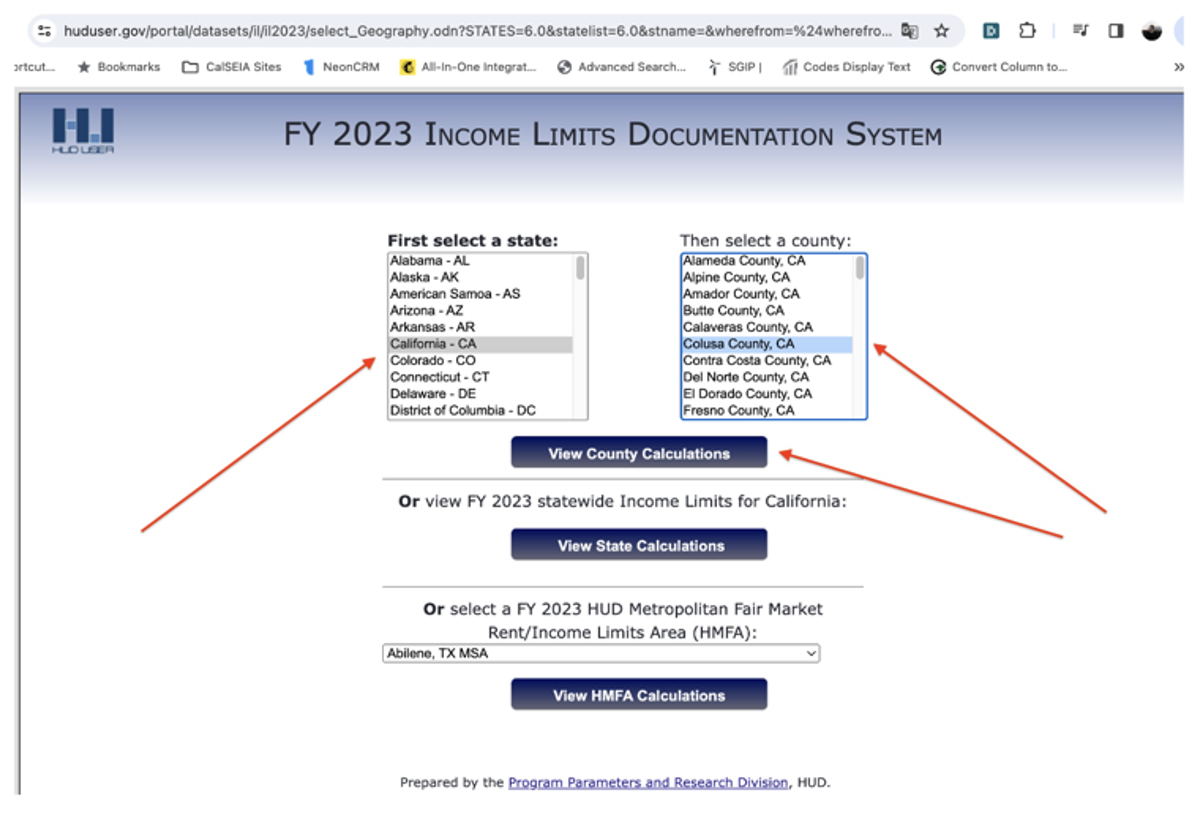
Look at the income limit in the grid for the corresponding number of persons in the family.
Multifamily residential properties may qualify for the budget if:
a. The property is at least five rental units and is either: (1) located in a “disadvantaged community” or in Indian Country, or (2) “Is a building where at least 80% of the households have incomes at or below 60% of the area median income,” or,
b. It has reserved funds in MASH or SOMAH.
Disadvantaged Community is defined by SGIP as “Any census tract that ranks in the statewide top 25% most affected census tracts in the most recently released version of the environmental health screening tool, CalEnviroScreen, plus those census tracts that score within the highest 5% of CalEnviroScreen’s pollution burden, but do not receive an overall CalEnviroScreen score.” Indian Country is defined here.
Program Administrators (PAs)
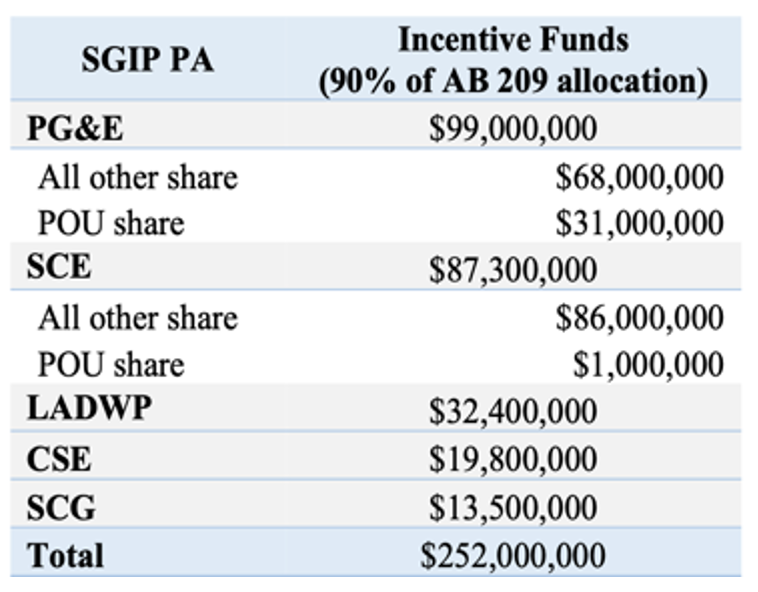
Because the RSSE budget is funded with taxpayer funds rather than ratepayer funds, it is available to all California residents, including all Publicly-Owned Utility (POU) customers. The budget is administered by five PAs: PG&E, SoCalGas, SCE, CSE (which administers for SDG&E) and LADWP. All LADWP customers are overseen by LADWP. To determine which PA oversees which POU Customer, go here. Electric customers of POUs will have to disclose their POU at the RRF stage. Budget allocations by PA are as follows:
Incentive Amounts and Funds
Storage is incentivized at $1,100/kWh. The solar incentive is $3.10/W when added with the storage. Roofing costs are not eligible in this budget but service panel and wiring upgrades up to $3,500 continue to be permissible, as do inverter replacement if it is required for storage or if the existing inverter is either over 10 years old or out of warranty. Meter collars and meter socket adapters are an eligible project cost.
Investment Tax Credit (ITC) Treatment and Third-Party Ownership (TPO)
Treatment of the ITC depends on whether the funds are ratepayer versus state funds. The RSSE budget was previously called the Residential Storage Equity Budget and was funded by ratepayers. For ratepayer funded projects, applicants must list the percent of the total project cost they expect to receive from the ITC. If the combination of the ITC and SGIP is greater than the total eligible project cost of the system, there will be a commensurate reduction in SGIP. Importantly, the Commission has noted that any SGIP payment is applied to the basis cost of the system and the ITC is taken on the net. For example, if the total eligible project cost is $30,000 and SGIP provides $27,000, the customer’s ITC would be 30% of $3,000, or $900. Because $27,000 plus $900 equals $27,900 is less than the total eligible project cost of $30,000, there would be no reduction in the SGIP payment.
For state funded SGIP funds, which is the majority of the RSSE Budget, SGIP would not be applied to the basis of the system, meaning customers with sufficient tax appetite would claim the full ITC. However, the exact treatment depends on whether the system is customer-owned or third-party owned (TPO).
For a customer-owned system, if the customer’s tax appetite is such that multiplied over five years, they could claim the full value of the ITC, their SGIP payment will be reduced by 30% of the total eligible project cost. As an example, if the total eligible project cost is $30,000, the ITC should be $9,000 ($30,000 x 30%). For a customer to claim that full $9,000 of the ITC over five years, the customer’s tax liability would need to be at least $1,800 ($9,000 divided by 5). If their tax liability is no more than $1,700, the SGIP payment will not be reduced. However, the Commission says the customer will also, “…need to demonstrate why the credit could not otherwise be utilized or transferred by a third-party entity to receive an exception to the 30% tax credit deduction.” Also, of note, the fact that a developer may not offer a TPO product is not an acceptable justification for why the credit could not be transferred or utilized by a third-party. It is unclear what justification the PAs will accept.
For TPO, the developer will claim a minimum 30% ITC on the total eligible project cost and more if they intend to take any IRA bonus credits such as the domestic content or energy community adder. However, the SGIP rebate may be modified at the ICF stage if the developer was unable to claim the expected adders, and the SGIP rebate may be increased if there are sufficient funds and the developer provides documentation as to why the adder could not be claimed.
PV
The PV incentive is $3.10/W for a PV system installed at the same time as a storage system in the RSSE budget. Projects at or below 5 kW do not need to provide a load justification. Multifamily housing has a default of 5 kW times the number of tenants. Multifamily buildings proposing larger systems will need to submit aggregate load data, which may include common area usage.
Developers sizing systems greater than 5 kW will use the Expected Performance-Based Buydown (EPBB) calculator to determine adjustments to the solar rebate amounts. This requires system designers to evaluate factors such as location, size, shading, and orientation in their design. The EPBB calculator compares these against the output of an optimally designed reference system, applying adjustments for Geographic Correction, Design Correction, and Installation Correction. Together, these adjustments form the Design Factor, representing the system’s efficiency as a percentage of the ideal reference system’s performance. The Design Factor is used to scale the incentive payout. For example, a system with a design factor of 90% will receive 90% of the standard SGIP rebate. Of note: systems with arrays of different tilt and azimuth will need to do multiple entries into the EPBB calculator and combine them to account for these differences.
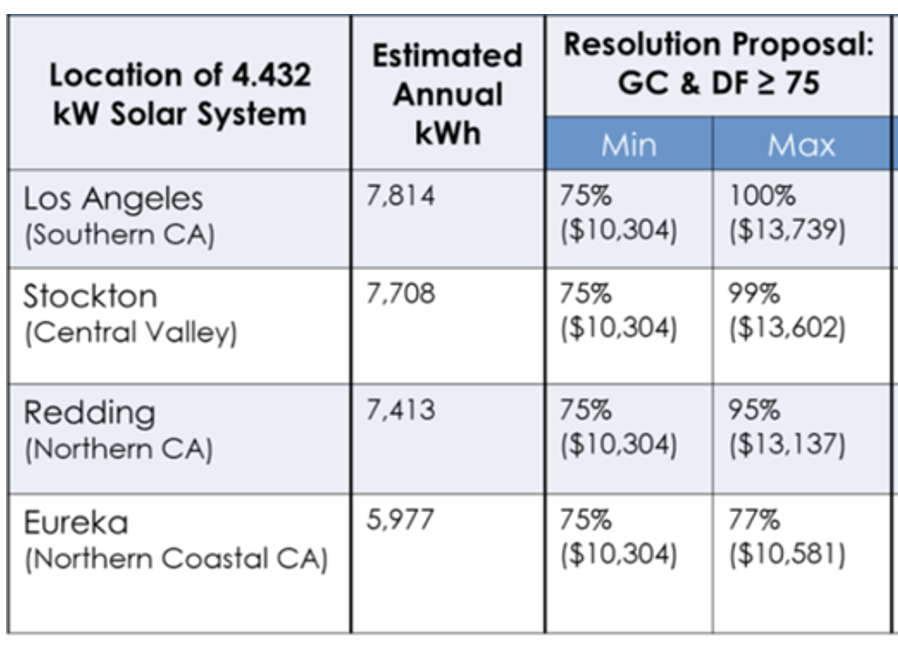
There will be a minimum acceptable Design Factor of 75% as a baseline of performance for all systems. Due to the Geographic Correction, systems located in northern latitudes may have smaller rebates. The Commission has also mandated the development of an updated EPBB calculator, although no specific timeline has been provided for its implementation. The Commission presents the following table as an example of how the Design Factor impacts incentive amounts for similarly sized and designed systems in four different regions in California.
Systems can receive rebate reservations for sizing up to 150% of historic usage to account for anticipated load growth. However, this load growth will need to have materialized by the time of the Incentive Claim Form (ICF). If load grows more than 150% between the rebate reservation and the ICF, funding is still capped at the system size proposed during the Reservation Request Form stage. If load grows above baseline but not to the anticipated load growth amount, SGIP will pay up to the actual load growth.
Advanced Payment Program
To remove barriers to participation in the RSSE budget, the CPUC ordered the PAs to set up an Advanced Payment Program (APP) for participating developers where half the SGIP rebate would be paid directly to the contractor at the RRF stage and the other half at the ICF stage.
Before participating, developers must first be approved by the PAs, which requires they:
Be an SGIP approved developer in good standing;
Provide a Certificate of Insurance for Commercial General Liability;
Possess Business Auto Insurance;
Provide a signed Upfront Incentive Agreement Form for each project;
Not be in the process of dissolving or filing for bankruptcy; and
Annually recertify the above.
Additionally, developers must maintain an active CSLB license, have successfully
completed at least one residential SGIP project, not be on the CPUC’s Public Watch List of Non-Compliant Solar Providers, and they may be excluded if their Better Business Bureau (BBB) rating is a B or less (those without a BBB rating may still participate). Developers must adhere to a no-money-down policy, meaning they cannot charge customers upfront before project completion.
All developers participating in the APP must complete their projects within 180 days of the RRF approval. They may receive only one six-month extension (instead of the usual three) unless it is a tribal customer. However, the developer may be granted the standard three extensions within the SGIP program so long as they return the upfront incentive (they would receive the full amount upon completing the program like the typical SGIP rules).
Developers are subject to a $1,000,000 cap in the APP without an Investment Grade Credit Rating. If the developer has an Investment Grade Rating of BBB-/BAA- or above with Finch Ratings, Moody’s, and S&P Global Ratings, their APP cap will increase to $2,000,000 in SoCalGas (SCG), Center for Sustainable Energy (CSE) or Los Angeles Department of Water and Power (LADWP), and $5,000,000 statewide. The APP application process should be available when the RSSE budget goes live.
Battery System Sizing Rules
Previously, SGIP required single-family residential customers to demonstrate sufficient peak demand to justify batteries larger than 10 kW, even though the incentive was paid out in kWh. The program has now changed the rules such that single-family residential customers need to demonstrate sufficient kWh load, not kW demand.
The new load calculation for solar and storage customers is a single summer month’s solar generation minus the same month’s consumption divided by the days in the month, as follows:

This load justification is not needed for battery units up to 15 kWh. The energy consumption is obtained from customer Green Button Data. The PV production will come from the EPBB calculator referenced above. The calendar month should be a full summer month between June to October and should be all the data from a single month (i.e. June 1 to June 30, not June 15 to July 15). This practically means that under this formula, a solar system would need to be massively oversized to justify a system larger than 15 kWh, and that is likely prohibited by interconnection. This likely means most customers will not be able to get funds for more than 15 kWh. The program will fund one full unit up to 15 kWh, and will fund the first 15 kWh of a larger unit for single-family residential customers.
For standalone storage, the system size is determined by the customer’s consumption from 4-9 during a summer month divided by days in the month, as follows:

SGIP will no longer provide incentives for single-family residential batteries larger than 30 kWh. Customers may install batteries larger than 30 kWh, but SGIP will only fund the first 30 kWh. Multifamily projects will use a 12.5 kWh per tenant load justification threshold.
There have also been changes to battery modularity rules for both the Equity Resiliency and the RSSE budget. Previously, for Equity Resiliency customers, if a customer’s kW demand was greater than the capacity of one battery unit, the customer could size to one additional battery unit. Under the new rules, this is only allowed for Equity Resiliency customers if more than 50% of the capacity of the additional unit is justified by the load calculation. Customers in the RSSE budget can also add a unit with at least 50% capacity justification if they meet one of the resiliency requirements for the Equity Resiliency budget. These requirements are that the customer must meet one of the following:
Live in a tier 2 or tier 3 high fire threat district.
Have had their electricity turned off due to two or more discrete Public Safety Power Shutoff (PSPS) events prior to their SGIP application date.
Have had their electricity turned off due to one discrete PSPS event and one de-energization event or power outage due to an actual wildfire after January 1, 2017.
Have had their electricity shut off due to five or more Enhanced Powerline Safety Setting events since January 1, 2023.
You can access the new SGIP storage sizing calculator tool here. Go here for a video walk through guide of the calculator and here for slides of the same walk through.
Demand Response Requirements
Though participation in a qualified Demand Response (DR) program was initially required in the RSSE budget, it was later removed through a Commission decision in the fall of 2025. DR participation is still required for all other budgets.