MEMBERS-ONLY FACT SHEET
Title 24 JA 12 Battery Standard for New Construction
Last Updated October 20, 2025
The 2025 California Code of Regulations, Title 24, Part 6—also known as the 2025 California Energy Code—requires the installation of battery energy storage systems (BESS) in newly constructed commercial buildings, including but not limited to grocery stores, offices, schools, and high-rise multifamily apartments and condominiums.
While BESS installation is not mandatory for new single-family homes or low-rise multifamily buildings, installing a system in these cases offers builders a self-utilization compliance credit. This credit can be traded against other efficiency measures, such as those related to the building envelope or installed equipment, such as insulation, windows, HVAC, or lighting.
The biggest change in the 2025 update to these rules was requiring residential batteries to default back to a cycling mode every 72 hours. Customers can switch out of cycling mode in preparation for storm activity or for any other reason, but the system will default back to cycling mode after 72 hours.
BESS Compliance Requirements
All BESS installations seeking compliance credit must meet the requirements outlined in Joint Appendix JA12. Central to JA12 is the requirement that systems follow one of several approved control strategies to ensure “daily cycling for the purpose of load shifting, maximized solar self-utilization, and grid-harmonization.”
Although California’s Net Billing Tariff effectively guarantees daily battery cycling, these control strategies are meant to prevent users from disabling battery discharge in favor of keeping batteries fully charged solely for emergency backup.
The control strategy options are:
JA12.3.3.2.1 Basic Control
Requires that the BESS charges only when the PV production is greater than the on-site electrical load. This means that users cannot direct the PV to charge the battery and use power from the grid for their home loads. Instead, the PV must go towards the home loads, and only excess PV production can be used to charge the BESS. The BESS must also discharge when the PV production is less than the on-site electrical load. Meaning that the home loads must be served from the BESS first, before drawing from the grid.
JA12.3.3.2.2 Time-of-Use (TOU) Control
Requires that the BESS discharges during the highest priced TOU hours of the day. The system must be capable of programming three separate seasonal TOU schedules, such as spring, summer, and winter.
JA12.3.3.2.3 Advanced Demand Flexibility Control
Requires that the BESS be programmed to either Basic Control or Time-of-Use Control, and meet demand responsive controls requirements, in order to respond to signals from the load serving entity or third-party aggregator to change the charging and discharging periods.
JA12.3.3.2.4 Controls for Separate Battery Energy Storage Systems
For BESS without an on-site solar PV system (e.g. community solar,) the BESS is required to either:
1) Charge from the grid during the lowest priced TOU hours of the day and discharge to the grid at the highest priced TOU hours of the day.
OR
2) Meet the demand response control requirements, and have the capability to change the charging and discharging periods in response to signals from the load serving entity or a third-party aggregator.
JA 12.3.3.2.5 Alternative Control Approved by the Executive Director
Allows an alternative control strategy, if approved by the Executive Director of the California Energy Commission (CEC). To qualify, the BESS would be required to operate in a manner that increases self-utilization of the photovoltaic array output, responds to utility rates, responds to demand response signals, minimizes greenhouse gas emissions from buildings, and/or other strategies that achieve equal or greater benefits of the other control strategies
Non-Export Systems
JA12.2.3.1 (Basic Control Option) allows non-export systems. While JA12.3.3.1(c) states that BESS must have the “capability to discharge electricity into the grid,” the California Energy Commission (CEC) has clarified that capability does not require specific programming or installation features. As such, batteries may be configured as non-export while maintaining compliance.
72-Hour Auto-Reset Requirement for Single-Family Homes
(Effective January 1, 2026)
Beginning January 1, 2026, BESS installed on new single-family homes earning compliance credit must be capable of automatically resetting to a “compliance cycling capacity” every 72 hours. The compliance cycling capacity is set at the time of commissioning.
If a builder uses Exception 5 to Section 150.1(c)14 and adds a BESS to reduce the PV system size, the minimum cycling capacity must be 7.5 kWh. Otherwise, the following can be used to set compliance cycling capacity:
Compliance Cycling Capacity + Reserve Capacity = Usable Capacity
The reserve capacity is not subject to the cycling capacity.
The usable capacity is the amount of energy the BESS manufacturer makes available for use, different than the total capacity
For example, at commissioning, the BESS is set with a 20% reserve capacity. This 20% is not available for daily cycling, and is held in case of a grid outage. The remaining 80% is the compliance cycling capacity and used for daily cycling.
Under JA12.3.3.1(e), if the available cycling capacity drops below its commissioned level (e.g., if a customer increases the reserve setting), the system must automatically reset to the compliance cycling capacity within 72 hours.
This reset requirement does not apply to a reserve level change due to a severe weather event or Public Safety Power Shutoff. However, at the conclusion of the event, the BESS must return to the compliance cycling capacity set at commissioning.
Manufacturer Certification
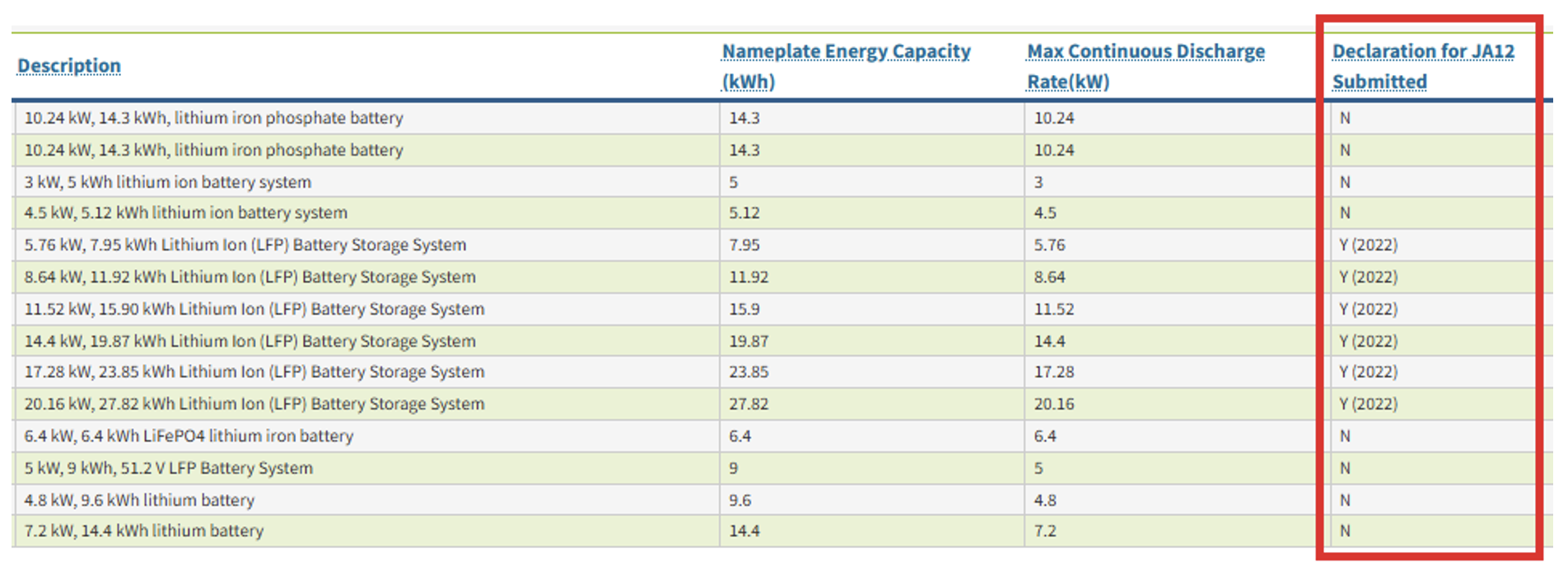
BESS manufacturers must submit a Declaration Statement to the CEC verifying that their systems meet the 72-hour auto-reset requirement. Upon verification, compliant models will be listed on the CEC Equipment List with the designation: Y(2025)