
Members-Only Fact Sheet
Virtual Net Billing and Virtual Aggregation
August 16, 2024
In November 2023, the CPUC finalized NEM-3 versions of Virtual Net Energy Metering (VNEM) and Net Energy Metering Aggregation (NEMA).
The new tariffs are called Virtual Net Billing Tariff (VNBT) and Net Billing Tariff-Aggregation (NBTA). Below are some of the main features of the new tariffs.
None of these changes apply to properties enrolled in the SOMAH or MASH programs. Those systems effectively stay on NEM-2 with a 20-year term. This will remain true for all SOMAH and MASH properties through the life of the programs.
Self-Generation Versus Exports
VNBT allows unit-level netting for residential accounts but not for commercial accounts. NBTA does not allow any on-site netting. Without netting, all generation is treated as exported energy compensated at the very low export rates derived from the Avoided Costs Calculator.
As with VNEM, credits in VNBT are distributed to benefitting accounts according to percentages that the customer selects on the allocation spreadsheet. In each 15-minute billing interval, each residential customer’s share of the generation offsets their consumption, just like with regular NEM. The portion they are not using, however, is credited according to the ACC export rate for that hour. Under NEM, generation beyond consumption results in a credit that is applied against consumption at other times. Now generation that is not consumed at the same time is essentially cashed out in each billing interval.
As an example, if the residential customer consumes 6 kWh in one 15-minute interval and the generation credit is 5 kWh, they are only billed for 1 kWh. If the customer consumes 3 kWh and the generation credit is 5 kWh, they are not billed anything for that interval and get a dollar credit of 2 kWh times the $/kWh export rate for that hour.
Commercial customers in VNBT and all customers in NBTA do not have any netting of generation against consumption for benefitting meters. All of the generation allocated to each meter is valued at the export rate. They pay full rates for all of their consumption and get ACC-based dollar credits for their share of the generation.
Under NBTA, the system can be installed on a meter with load. That meter will net consumption and production to provide behind-the-meter value for solar on that single meter. Under VNBT, the generator must be installed on a new meter with no load, so there is no netting for that meter.
Export Rates
VNBT and NBTA use the same export rates as the single-meter NBT. The export rates are the same for residential and commercial accounts.
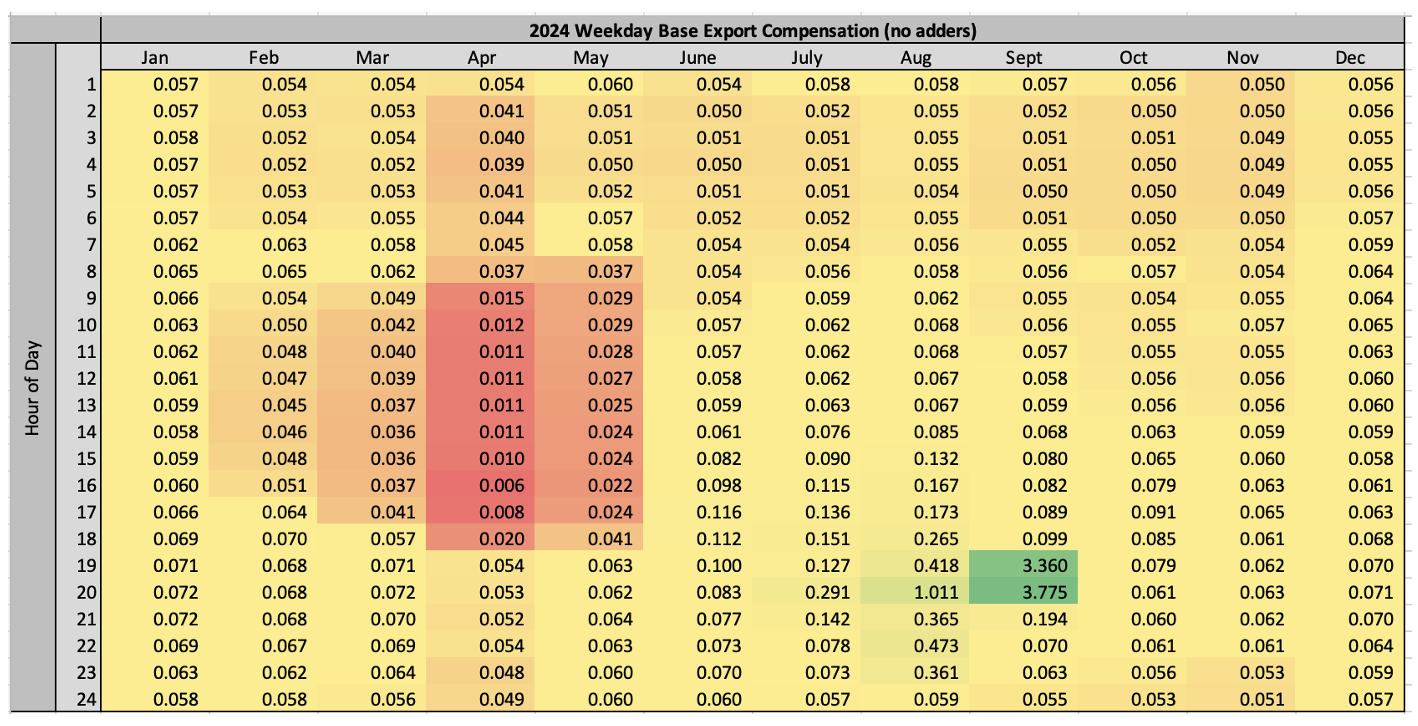
The export rates vary hourly. Each month has 24 hourly values for weekdays and 24 hourly values for weekends.
A sample of the export credit values is below for SCE customers on weekdays in 2024. You can download a full set of export values for PG&E, SCE, and SDG&E on CALSSA’s website.
Lock-In of Export Rates
The export rates are different for each year. You can see the rates for each year in the future in the files linked above.
The Avoided Cost Calculator will be updated every two years, resulting in new numbers for the export rates in future years. Customers that install in 2024-2028 will have the option of sticking with the rates that were in place when they interconnected or moving to the updated rates. This option will expire nine years after interconnection. From then on, when the ACC changes, the customer’s export rates will use the updated values.
Export Rate Adders
For PG&E and SCE residential accounts in both VNBT and NBTA that install solar in 2024-2028, there are adders that increase the export rate for the first nine years. The values for customers that install in 2024 are in the table below. Customers that install in 2025 will get 80% of these values for nine years. Customers that install in 2026 will get 60%, etc.
| Utility | Low-Income Tariff Enrollees | Non-Low-Income Tariff Enrollees |
|---|---|---|
| PG&E | $0.090 kWh | $0.022 kWh |
| SCE | $0.093 kWh | $0.040 kWh |
| SDG&E | $0.000 kWh | $0.000 kWh |
Low-income customers are defined as: (1) customers on CARE or FERA rates, (2) customers living in disadvantaged communities in single-family homes (of any income level, but VNEM is rare for single-family homes), and (3) customers in California Indian Country.
For VNBT, the export rate lock-in and the export rate adders stay with the system if there is a change in ownership or tenancy. The new owner or tenant takes over the remainder of the lock-in period and adders. NBTA customers, in contrast, lose these components if the property is sold unless it is sold to a legal partner.
Import Rates
Residential VNBT customers must be on any available TOU rate schedule. Residential NBTA customers must be on the electrification rate. Commercial customers in both tariffs can be on any rate they are otherwise eligible for.
Sunset Period
Customers submitting interconnection applications free of major deficiencies by February 14, 2024 will be eligible for the NEM-2 versions of VNEM and NEMA for nine years from interconnection.
VNBT and NBTA customers interconnecting before March 31, 2025 for SCE and SDG&E, and June 30, 2025 for PG&E, will be billed on VNEM and NEMA until those dates. There will not be a reconciliation after the updated billing begins.
Both VNEM 2.0 and NEMA 2.0 projects have 3 years from the application deadline of February 14, 2024, to submit final building permit and electrical clearance from the AHJ. In other words, those items must be submitted to the utility before February 15, 2027. If you are unable to meet this deadline due to delays caused by the utility, such as pending grid upgrades, this deadline may be extended at the discretion of the utility.